Thursday, September 18, 2014

'Destiny' Fulfilled? Slick Action, Jaw-Dropping Visuals Redeem a Surprisingly Shallow Shooter

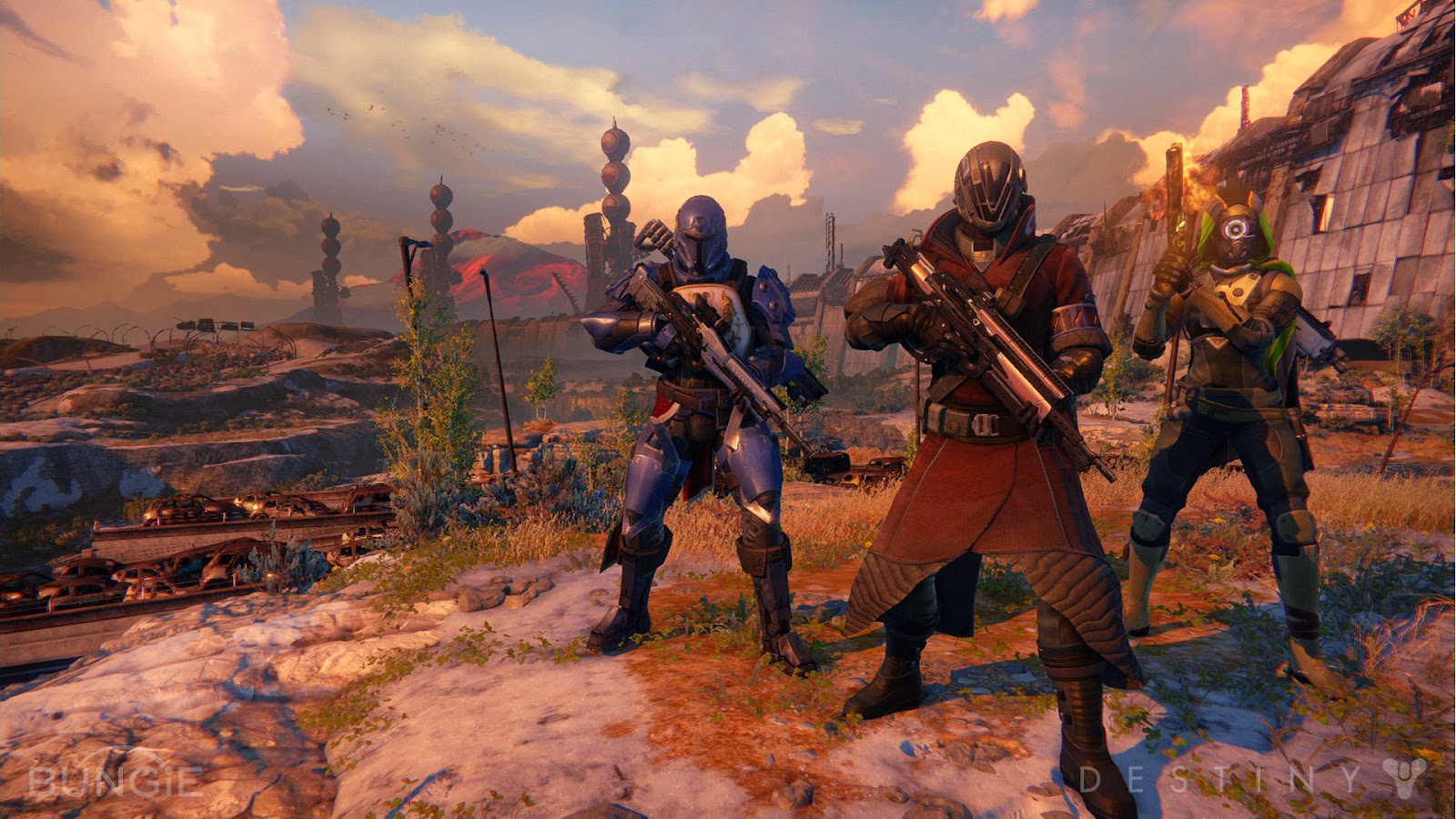
Views like this make it all worth it...
Abraham Lincoln said 'You can fool all the people some of the time and some of the people all of the time, but you cannot fool all the people all the time'.  Replace the word 'fool' with the word 'please' and you have an accurate summation of Destiny.  Not that folks who brought you Halo and its wildly successful sequels didn't try to be all things to all people, but it's easier to mention what Bungie Studio's new nine-figure opus isn't instead of what it is.  It ISN'T a role-playing game, it ISN'T an MMO, nor is it a plain vanilla 'shoot-the-bad-guy-bad-guy-falls-down' splatterfest.  It's like your first plate off the buffet line: a heaping mix of all those elements pureed with starchy post-apocalyptic flotsam and a heavy squeeze of arena combat slathered on top.  It fails to master any one of these elements but compensates for it by offering carpal tunnel-caliber quantities of everything on the menu.  It looks incredible and it's a lot of fun but, like even the best buffet in town, I wouldn't want to eat there every night.

Gameplay can be parsed into four categories.  Story Mode takes you through Destiny's narrative such as it is and presents you with a series of gradually more challenging scenarios, mini-bosses and end-level foes.  Progress here opens the map to new areas of the solar system for you to explore, from your starting point on Earth to Earth's moon, Venus, the asteroid belt and Mars.  Each of these settings is essentially a giant, highly detailed arena to which you will return again (and again) many times as you complete story-driven tasks.  Patrol is free play, a chance to romp over hill and dale killing as you go from the endlessly respawning supply of enemies. Here you can complete side missions for additional XP, cash and bonus loot.  Strike missions are three-man jobs that pit a fireteam of real dudes (that's you, and maybe your buddies) against high-level enemies and obstacles crafted specifically for this mode of play.  The XP and bonuses are big, but you have to play as a team (ugh).  Finally there is the Crucible, Destiny's all-purpose fight club where players engage in that timeless measuring of dicks known as PvP.  This is for people who enjoy the human aspect of a shared world game but won't get their money's worth until they've cornered an 10 year-old from Saskatchewan and shot him in the face with a space revolver.

If you couldn't tell, I'm a bit of a humbug when it comes to the more social aspects of the Destiny experience.  I dabbled in Massive Multiplayers, found I didn't care for them, and generally subscribe to the tenet that video games are best for escaping real people, not for bumping into still more of them.  I know many would argue that human players offer a different sort of challenge from computer foes, of which even the smartest remain pretty predictable.  No argument there, and at least as concerns the Strike missions I know I should be more of a participant.  But dueling random dudes and dudettes has never interested me; I fight enough such specimens when they merge into my lane during morning commute.  On the battlefield you're likely to stumble into a fracas-in-progress between a squad of goons and fellow Real Person.  Whether you join in is up to you, but as a lone wolf I know I wouldn't want anyone doing my fighting for me, so I tend to give my fellow Real People plenty of space.  I'm not much of a sharer, and if you're reading this for greater insight on Destiny's interactive elements, you might want to look elsewhere.

[ADDENDUM: Before posting this review I did participate in one of Destiny's 'Public Events', sort of communal free-for-all missions with big enemies and high-risk, high-reward combat.  The job here was to take down one stubborn foe with a lot of HP. Initially only myself and one other chap participated and we were badly outclassed, but Public Events are announced to all players in the area and in moments backup had arrived in the form of five other players.  We dog-piled on the guy and killed his ass, winning a 'Gold Tier' commendation and some fancy loot.  This constitutes only my second online interaction of my Destiny experience, the first being when I waved to a guy.]

So what's an antisocial scoundrel like myself to do?  There's grinding off course, hosing bad guys left and right purely for the purposes of leveling up and scouring better swag. Here at least Bungie provides ample incentive to put in the hours.  Your Guardian – either Titan (bruiser), Hunter (rogue), or Warlock (wizard) can equip a generous compliment of weapons that fall into broad categories – Main, Special, and Heavy – but there are no restrictions on which class of character can use which weapons; you are free to use what you like and pawn what you don't.  Weapons you do favor often attain special modifications and performance bonuses you can activate for a modest one-time fee, ensuring your tried-and-true armaments won't be overshadowed by the every shiny new thing.  The same goes for armor, which in a shared social game like Destiny is as much a badge of honor as the number over your name – players with the most tricked out threads are generally the most badass, and for myself (a Hunter) I confess a certain pride in achieving Level 10, ditching my beginner's scarf and donning a full-fledged cloak. I mean, c'mon...people are looking, after all.  Your character's skill trees are large and require patience to unlock all the way, but the upgrades are (mostly) worth the wait and you're even allowed to swap between certain skills depending on your style of play.  It's a thoughtful system that keeps you hungry, humble, and on your toes.

Bungie further pads the grind aspect by integrating other forms of currency with correspondingly awesome rewards.  Vanguard Points are awarded for completing Patrol bounties and Motes of Light – awarded for dispensing enemies with your special attack – can be redeemed for special gear.  The problem with ALL these currencies is that they are hard to come by, slow to accumulate, and a bitch to remember which goes where.  The developers clearly recognized the need to give the player a reason to keep picking up the controller once the story was done.  The varied coinage – and the glacial rate at which bonuses accrue – dangle just enough carrot over the average gamer to keep him coming back, bleary-eyed and stiff-backed, chanting the ceaseless mantra “one more mission, one more mission”.  I know because I'm guilty of this myself, which is a testament at least to how well the Halo makers know their audience and how to keep them hooked.
'Okay, now I KNOW this isn't the line for Comic Con...'
So what is Destiny about, anyway? Good question. I'll let you know when I figure it out.

I jest, but only kinda.  If there's a weak link in this title's presentation it is definitely the thin and utterly baffling plot, a hazy soup of disjointed backstory, foggy technobabble, and muddled sci-fi tropes. What I do know is you (good guy) must discover the mysteries behind the benevolent Traveler (big floating sphere guy) and it's arch-nemesis the Darkness (bad guy) by exploring the ruins of humanity's once great civilization before it was destroyed by evil jerkwads. Sounds like a lot of stuff you've heard before, only Destiny attempts this without a single fleshed-out character or passable line of dialogue.  Your hero begins a blank slate and remains so throughout, barely uttering three full sentences during the (rare) cutscenes as he/she (passably) interacts with a supporting cast of monotone dullards.  Considering the caliber of the script, however, reticence is probably a good thing.  Here's my favorite doozy: “They're so evil they even despise all other evil.” Well shit, I'm no expert but that sounds really evil to me.  Add to that a disembodied central villain with no face or voice and a horde of terra cotta enemies that never feel threatening and it becomes damned difficult to stay engaged. This is the Star Wars prequels with shaken baby syndrome.

Story missions are light on red meat and heavy on the breadcrumbs, as in the trail of breadcrumbs you follow mission after mission, killing hordes of underlings then waiting for your floating eyeball AI named Ghost (Game of Throne's Peter Dinklage) to tell you why you're here, at which point Ghost spouts some flummery about decoding signals and ancient evils. Shoot some stuff, get some loot, mission ends, good show, ripping job...now do it again. It is repetitive, it is predictable, and though it provides more variety than Patrol mode, like Kathy Griffin, it can't avoid getting old forever. Dinklage gets a decent selection of lines, though we hear them through a tinny filter and can glean only a flutter of emotion.  Much was made of the 'woodenness' of his performance during Destiny's alpha and beta testing, but considering what Mr. Dinklage is made to work with I think he does just fine; he's also the closest thing you're going to get to a real performance in this game, making it akin to a damp sponge in the midst of a barren desert that feels like a gushing oasis.

But at least your eyes will be entertained.  Come what may, Destiny is a joy to look at. On a PS4 the light, shading, textures and colors are all sublime, with a degree of fine detail probably not seen on the next-gen systems thus far.  Action, in particular gunfights, are varied and seamless with no noticeable lag or chop even when the screen is afire with warriors and ordinance.  I wish there was more time to just gawk at the scenery but a shared world waits for no man, especially when the bad guys can shoot you even when you hit 'Pause'.

Around hour five or so the thought will likely hit you (as it did me): what's missing? Were we swindled by Bungie, who promised us the world and failed to deliver? Why does this review join a chorus of others expressing a similar sentiment – that we signed up for filet mignon and ended up with ground chuck?  If we were promised a vast and expansive world, why do the various settings eventually feel like cages?  Why the repetition? Why the emotional disconnect?

Well, Bungie surely did what any game developer would do, which was market their game as aggressively as possible – a $500 million price tag doesn't leave a company many other options for securing a RoI. Looking back on the trailers and demos, the E3 showcase and the beta feedback, it was easy to be hornswaggled into thinking the finished version would be an epic of never-before-seen proportions, a Lord of the Rings meets Firefly with a liberal dash of Elder Scrolls.  Alas, if anyone can be accused of having head-in-clouds syndrome it's us, the players.  I believed the hype, too, and I was prepared to surrender a considerable amount of free time to mastering the world of Destiny in much the same way I did Skyrim: with a measured, methodical approach that allowed me to explore the whole of the virtual world, wander at a Gandalf-ian pace and see the sights. Alas, you can't do that.  The virtual world is a coliseum of carnage dressed in pretty gems and the stark plains and rolling hillsides are drenched in alien goo.  We'll have to wait another day for a truly immersive space story in the next-gen. Until then all we can do is shoot.

Bungie promises added replay value in the future. This isn't just a shared world, after all, it's an online one, constantly growing, updating, and refining itself.  Scheduled events called 'raids' offer Woodstock-like gatherings of Guardian faithful for the chance to participate in epic showdowns, and the currency system ensures there's reason to grind even after hitting the 'soft' level cap of 20. Is Bungie covering it's butt, stung, perhaps, by the lukewarm feedback?  Or have we really come in on the ground floor of a new paradigm in gaming, that of a collective universe where developer and player(s) interact continuously and the best is yet to come?  It's possible that a year or two from now the initial Destiny experience may be just growing pains on the way to a game-making revolution that may, among other things, leave curmudgeons like myself in the dust.  In the meantime I plan to enjoy Destiny for what it is and not dwell on what it isn't. I may not like sharing my world, but I am an eternal optimist.

Monday, August 4, 2014

Ludicrous Speed - Break-Neck Plot Propels 'Guardians of the Galaxy' to a Win

Sorry, the other maid service was booked solid...

Guardians of the Galaxy is the tale of a ravenous, despotic power forced to overcome a stubborn, slippery foe and achieve the unachievable.  

Yes, let's talk about the Disney Corporation for a moment, and the odds stacked against it with the release of this thoroughly fun flick.

Okay, the House that Mickey Built seems at times like the Third Reich of American Media, having gobbled up ABC, ESPN and LucasFilm Ltd. to namedrop some of their juiciest booty. But while 'Castle', 'SportsCenter' and a little start-up called Star Wars will no doubt bear fruit for years to come, Disney's chief child soldier is and will remain Marvel Worldwide Inc. and its vast lexicon of eminently popular, eminently bankable characters in this, the golden age of super hero cinema.

But space is cold, hostile and cruel, and the milieu in which space movies have been forced to compete for the box office is hardly better.  Survival, much less profitability, is a dubious prospect if it isn't from a grandfathered franchise with serious name recognition. Serenity and Avatar come to mind as the last truly noble efforts to entice John and Jane Public to a film set among the stars that didn't have Wars or Trek in the title. Serenity, despite a built-in cult following, petered out. Avatar...did a little better.

Point is, Guardians of the Galaxy faced an uphill battle against a generally uninformed public that is historically apathetic when offered a sci-fi joint filled with unfamiliar faces and a bevy of technobabble. No lightsabers? No funny droids to dither and chirp? No Leonard Nemoy to smear gravitas on the lens and explain the plot with a clarion baritone? Not interested. Could even the Olympian might of the Marvel Machine overcome such an implacable nemesis? After all, Robert Downey Jr.'s coifed gourd poking out from the gleaming Iron Man armor is one thing. But a movie poster with exactly zero recognizable faces and no capes, no masks, no Hulk SMASH! and not so much as a glimpse of Scarlet Johannssen's...um...eyes? Another thing entirely.

Or so it seemed. As I write this, Guardians of the Galaxy appears to have conquered the foe. A $37.8 million dollar opening day began a weekend run that capped at $94 million by Sunday afternoon. That's better than Captain America: The Winter Soldier and Thor: The Dark World. Yes, Disney has beaten the odds yet again.

And I'm not going to begrudge them for a moment. Not this time. Because Guardians is more than just a crowd-pleaser; it's a damned entertaining, old school adventure that keeps you riveted and giggling, often at the same time. It is also a dyed-in-the-wool comic book movie, a whip-smart adaptation of a more obscure (but no less beloved) Marvel property, steadfast to its source material, totally reverent in its irreverence.

Meet Peter Quill (Chris Pratt), ordinary Earth boy abducted by space pirates (you know: pirates, but in space) practically from the foot of his mother's death bed to parts unknown for reasons unknown. A couple decades later he's a cocky, pistol-toting outlaw/thief/puckish rogue known by the oft-mocked moniker 'Starlord'. Quill makes his living desecrating alien tombs for unscrupulous treasure brokers, which he does with gusto and class and an arsenal of groovy dance moves. Though he's spent most of his life in deep space, the awesome might of 80's America clearly lives on in his punchy, pop culture-suffused slang and his use of a Walkman for his musical accompaniment. Quill's latest score, a chrome-ish sphere called simply 'the Orb', is coveted by the tyrannical Kree Empire (looking a tad too much like the s & m antagonists from The Chronicles of Riddick) and its mysterious benefactor, the mad despot Thanos. Why? What for? Does it matter? It's a thin excuse for ceaseless action and mayhem on a biblical scale, and that's the only kind of excuse you need. At some point we'll get to the pesky reasons for everything, but until then it's just a matter of hanging on for the ride.

And what a ride. Starlord quickly runs afoul not only of the blue-skinned Kree but also the green-skinned killer hottie Gamora (Zoe Saldana) and a pair of wonky bounty hunters: Rocket, a short-tempered cad who also happens to be a genetically reconstituted raccoon, and Groot, an eight-foot tall humanoid tree - imagine Swamp Thing's good-natured younger brother. The former is an acid-tongued motormouth, the latter a monosyllabic simpleton (and it will take a better man than I to manage all the Vin Diesel jokes here) who can only say 'I am Groot', albeit with a multitude of subtle inflections that convey volumes of meaning. The early scramble and subsequent melee to secure the Orb results in all four heroes-to-be captured and jailed, thereby ensuring ample opportunity for them to bond, come to terms with stuff, and collaborate on a harebrained jailbreak that cements their loyalty to one another. Gosh, what are the chances?

The quest for fortune and glory takes a turn for the heavy when it is revealed that the Orb is a containment device housing one of the Infinity Gems, a revelation guaranteed to elicit an “Awww, yeah!” from anyone who read Marvel comics in the 90's (these hypothetical readers of the yore would happily tell you the Infinity Gem is actually one of a set of six which collectively imbue the user with powers at a level only God himself is supposed to have...but I'm getting ahead of myself). A minor demonstration of the little purple stone's titanic energies is plenty for Quill and his new friends to get serious and take the fight straight to the Kree, in particular the psychotic Ronan the Accuser, a standard S/F douche tired of taking orders from the aloof Thanos. Throw in loads of teeth-jarring action, some serious sibling rivalry, and a fifth hero in the form of Drax the Destroyer, a vengeful tank of a man too stubborn to lose, let simmer for two hours and you've got Guardians of the Galaxy.

What impressed me most about the film was its ceaseless momentum, a sort of focused hyperactivity that kept the plot plunging ahead and to Hell with whoever got lost along the way. This was accomplished thanks to a huge amount of narrative negative space: virtually all backstory is implied, assumed, or just outright ignored in favor of sheer kinetic thrust. Exposition is rare in this flick, and when it does become absolutely necessary it is fileted like fine oro tuna, leaving only the choicest bits for consumption; everything else is discarded as extraneous. Quill's twenty lost years and his transformation into Starlord are never once explained; it is merely presented to you as fact that he not only survived his ordeal but came away pretty badass for the experience. Similarly it is taken as a given that the Marvel Universe, previously grounded mostly on a real-ish Earth, is indeed rife with alien beings, cosmic entities, a corps of cosmic lawmen, and entire civilizations of humans not actually from our galactic cul-de-sac.

It's a bee, right?!  Oh, God, I hate bees!  Get it!  Get it!
A bloated script, a boorish cast or a compulsive insistence to explain everything would likely result in disaster with such an approach. But director James Gunn, whose previous credits include the horror-parody Slither and who shares credit for the abomination that was Movie 43, hurls Guardians like a guided missile towards the end credits and trusts the audience will simply be buoyed along in the updraft. He was right: generally you're having so much fun you never notice the (rare) misstep, which for me manifested primarily in Saldana's beige-plain delivery and general wooden-ness. It is not omnipresent – she gets some base hits here and there – but it is more noticeable when contrasted with an otherwise seamless cast. Offsetting it is that fact that the camera seems to adore Ms. Saldana and her glorious cheekbones, which motion-captured her way to our hearts in Avatar when her skin was blue instead of green (mind = blown). Color seems to be one of Gunn's strong suits; he even manages to make space itself look interesting, splashing the starry backgrounds with radiant nebulae and exotic cosmic décor that looks not unlike backlit sewage drifting through Waterford crystal.

Two other things help immensely: despite the frantic pace, Guardians of the Galaxy never fails to be funny and many times it also manages to be sweet. The low moments, those very brief pauses in the action, are reserved not for cosmic history lessons but for endearing character moments that humanize the otherwise invincible heroes and make each one of them feel less like archetypes (bruiser, assassin, thief) and more like people, good dudes you'd delight to swap stories with over warm beers at two in the morning. Groot gets the best of these moments, but a surprising runner-up is Dave Bautista's Drax, who manages pained contrition and a handful of wicked, low-key zingers with equal skill. And speaking of which...

Yeah, Guardians is freakin' funny. Granted, there's a bit of a shotgun approach to the humor, a sense at times that they were throwing every potential gag at the wall and seeing what would stick, but the yucks are pretty much all decanted from the same bottle: wry, sardonic, subversive and shit-eating. Rocket gets the best of this – in particular a time bomb-style gag involving a prosthetic leg that had my theater in stitches – and the delivery of Bradley Cooper as Rocket's voice is a welcome asset. On the whole I'm not a fan of Mr. Cooper – even in starring roles he always seems like he'd rather be somewhere else – but here he does much more than just phone in a quick buck from the sound studio, infusing the little rodent with equal parts Bill Murray and Andrew Dice Clay.

So it looks as though Marvel has unveiled the other end of it's Grand Unification Plan, having firmly established the Avengers and expanded comic universe Earth-side and now starting at the other end with Guardians and working toward the middle. The idea, presumably, is for the heroes of the last decade's worth of films to stretch out into space and confront the 'cosmic' threats that have so long been a part of Marvel's biggest arcs. We've already got a brief scene featuring Thanos (a comfortable Josh Brolin, effectively sporting stubble on his purple chin) and will no doubt be seeing more of the Infinity Stones, too.

Until then Marvel and proud papa Disney can once again sit pretty.

Those jerks. 

Thursday, May 29, 2014

World Enough and Time - 'X-Men: Days of Future Past'


Bryan Singer knows “X-Men” movies.

If you can take away just one thing from near-on fifteen years of mutants on celluloid, that seems a safe and solid observation. There's conservation of movement in the way Singer directs, a Bruce Lee sort of approach that is precise, efficient, and beautiful without being showy. Best of all, he can take a Jenga tower of a subject like the X-Men and trim its gangly, teetering, awkwardly complex universe down to two hours of red meat without ruining it. And he's had practice. After all, it was Singer who started us on this road in the first place; we've come so far down the now-illustrious superhero cinema trail people tend forget that fact. Fully two years before Sam Raimi's Spider-Man made it okay for normals to like comic book movies, Fox took a gamble on a cast of second-string actors, a pair of aging British thespians and one Australian soap opera hunk and plopped an afterthought of an X-Men film in the hands of the young director who many considered to be unblooded (though his trophy wall already boasted The Usual Suspects and Apt Pupil). By today's standards the first 'X' film must seem a spit varnish affair – short, structurally basic, heavily reliant on old-school stunts and utterly standalone, free of franchise considerations, tie-ins or long-term contracts. I remember opening night well; it was a tense couple of hours, myself and my closest friends in the world waiting to see if our faith in the inherent awesomeness of comics on the big screen would be validated or if our hopes would be dashed in a farcical showcase of cheese, ineptitude and apathy to the source material.

Things turned out pretty well, with Singer largely to thank for it. With X2: X-Men United he proved his slick, stylized approach wasn't a fluke, making an altogether better film that improved on every aspect of his freshman effort and enriching the mutant mythology a hundredfold. Now with X-Men: Days of Future Past Singer's back, a decade older and with at least one stinging failure under his belt. But did the turgid 5-bean burrito dump that was Superman Returns teach Singer some valuable lessons, or did it merely embitter him and tempter his exuberance with an excess of caution?

As to the latter, the answer is no. DOFP is vintage Singer: a smart, taut, compulsively watchable flick that is a winner both as a comic book film and as a top-notch addition to the X saga. It stands as at least as good an effort as X2 and oftentimes even flirts with being the superior film. It's a familiar-looking effort, no question – Singer finds his old groove and sticks to it – but it reminds us of all the things that made his vision of the X-Men so damn enjoyable in the first place (and lays bare how boorish and facile a job the other X-directors did in his absence).

We come into this film from a damnably strange place, the last few X installments having been bandied hither and thither by studio jockeys who – gosh, brace yourselves – seemed more concerned with pumping out money-makers rather than actual stories. Wolverine got two sub-par efforts in X-Men Origins: Wolverine (bad) and The Wolverine (meh), both star vehicles for Hugh Jackman that did nothing to enhance the subtle, complex Logan character and hopelessly muddied the myth/chronology of the X-world. The much better X-Men: First Class had loftier goals story-wise and the added challenge of carrying itself without the likeable Mr. Jackman (save for a blisteringly funny cameo), but it suffered from the syndrome so effectively described by comedian Patton Oswalt as 'Jon Voight's ballsack' – that is, do we honestly care where the story started, why Xavier and Magneto are enemies, how they came to be at loggerheads? Like the beautiful Angelina Jolie, do we really need know where it all came from? Point is, thanks to X-overload the average viewer at this point probably doesn't know a Morlock from an Ewok from a Deathlok.

With DOFP Singer attempts to sweep the table clear of narrative clutter and knock the franchise back into alignment, ignoring or outright eliminating many of the most egregious evils wrought by his understudies (killing Cyclops, anyone?) and putting the timeline back on True North. And to do it he delved into one of the most iconic and beloved X-stories of all time.

Days of Future Past was originally the brainchild of “X-Men” co-writers Chris Claremont and John Byrne, as potent a comic-making duo as ever there was (sadly, disagreements over the story contributed heavily to their eventual schism). It postulated an early 21st century in which Xavier's dream of human-mutant coexistence ended in spectacular failure due to the assassination of a prominent anti-mutant senator by the shapeshifting terrorist Mystique. Instead of cowing humanity into accepting mutant rule, the brazen murder only validated humanity's worst fears of mutants as a threat to their species. Cue the arrival of the Sentinels, automated killing machines designed to hunt and execute all mutants everywhere. In the comics the Sentinel's broad mission parameters caused them to go all SkyNet, expanding their pogrom first to all super-powered individuals and then finally to the humans who built them. The Sentinels take over the whole show, obliterate Earth's governments and infrastructure, and turn our world into a giant prison camp. Fortunately the mutant phaser Kitty Pryde hatched a plan that allowed her to warn the disco-era X-Men and stop the assassination from ever happening, saving the world. The film largely mirrors this story, albeit with some franchise-sensitive adjustments, and weaves a parallel narrative in which future and present actions occur simultaneously. The result, thanks to an intelligent script and a no-egos ensemble cast, is a damn good yarn that keeps the pressure up and the action at full blast.

Wolverine takes center stage yet again, assuming the time-traveling role originally meant for Pryde. This would be one of the franchise considerations I mentioned, as the X-films live and die by their star, Jackman, and the need to cram as much of ol' Canucklehead onto the screen as possible. No argument here – this is Jackman's best effort since X2. The plot device used to explain why Logan is needed for the time-jaunt is clever enough, although the writers play it fast and loose with other considerations, such as how Pryde (Ellen Page) can utilize her power to manipulate time in the first place (hint: they don't bother explaining). Suffice to say after a brief, violent introduction to the nigh-unbeatable Sentinels of tomorrow (and a fight/massacre scene that will NOT please the young 'uns) Logan is blasted back to the days of bellbottoms and promiscuous sex faster than you can say “Austin Powers joke!”. Any number of amusing Wolverine-as-a-clueless-time-traveler moments follow.

The would-be victim of Mystique's murderous intent this time is weapons scientist Bolivar Trask (a scene-stealing Peter Dinklage), inventor of the Sentinels and occasional mutterer of an anti-mutant slur. Trask mongers fear amongst the Washington elite, salting the wounds of the recently ended Vietnam war by comparing the South East Asian debacle with the coming race war between humans and mutants. This war, Trask insists, is winnable...if only the top brass has the balls to greenlight his controversial giant robot program (and when have giant robots ever NOT worked out great for all concerned?). Wolverine is tasked with reuniting the morose-but-mobile Charles Xavier (James McAvoy) and a younger Magneto (Michael Fassbender), a chore made even chore-ier by the fact that Xavier has been (conveniently) denuded of his psychic powers and Magneto remains a violent ideologue who has a hard time seeing the problem with Mystique's methods. The majority of the middle act is devoted to the patient build-up to the crucial moment when Mystique (the always enrapturing Jennifer Lawrence in all her body-painted glory) takes her fateful shot, but prior to that we are treated to two stellar sequences that are extreme crowd pleasers: the introduction of mutant speedster Quicksilver and the liberation of Magneto from his Pentagon holding cell courtesy of the most improbable – and hilarious – prison break ever.

But nothing is ever as it seems, nor should it be. Instead of stringing the audience along toward a single climax that might fall flat after two hours of anticipation, Singer and crew complicate Logan's mission in unexpected ways and turn what seemed like a cut-and-dried time travel joint into 'whoooa' territory worthy of Keanu Reeves. A classic destiny paradox intervenes – Mystique's initial effort is stopped, but the hero's actions only precipitate the course of their disastrous future rather than prevent it, setting up an infinitely more satisfying third act at the President's doorstep where Trask's “classic” Sentinels – the ones we geeks all know and secretly love – make their debut. Young Xavier, who spends most of the film moping, must ultimately sacrifice his legs and reclaim his mental powers in order to change the fate of the world. 

As with EVERY other X-film, the writers are forced to scramble for ways to alternately stymie, forestall or outright remove Xavier's vast telepathic powers from the mix because they are a story-killer: the man can literally do anything with his brain, prompting thousands of “why can't he just...?” scenarios that would bring a swift end to any conflict. But it's handled better here than before by giving Xavier an ethical quandary: though he has the power to simply “shut down” Mystique he doesn't want to, as he has a long and loving history with the misguided metamorph whom he still believes is capable of doing the right thing. Therein lies the heart of the matter: the dream of peaceful coexistence can't be won with superpowers; it has to come from the heart of every ordinary person. The conflict between universal acceptance versus forcing everyone to simply “see it your way” is revisited many times with many characters, heroes and villains, each time giving us a glimpse into the other guy's worldview but never plating up a simple black-and-white answer. Add to the brew the idea that “time is a river” as Hank 'Beast' McCoy suggests and that the Sentinel's rise might indeed be unalterable and you've got a film that has weight as well as muscle.

Fortunately Singer uses the future narrative to keep things extra-lively. The post-Sentinel apocalypse is indeed a bleak thing to behold, but it's rife with X-cameos and doesn't let up the tension for an instant. The handful of mutants still free are a hunted bunch, constantly running from the next-gen Sentinels who have chameleon-like adaptive abilities that cannot be overcome (a tribute to the 'Nimrod'-class machines from the comics). Old Xavier and Old Magneto have long since buried the hatchet and now lead these stragglers from New York to Moscow to China while desperately trying to keep Logan tethered like a balloon spider between present and past. But the Sentinels are always hunting, always running them down, and that the heros will be overcome yet again is inevitable. There's ample hand-wringing to go around.

I can imagine comics purists balking at some of the future stuff. The script leaves a yawning gulf between the assassination of Trask and how all of Earth – or at least two of its most important cities – became a desiccated wasteland. A few snippets of dialogue fudge the explanation as best as possible, trying, I assume, to avoid too many comparisons to Terminator (i.e. the Sentinels became self-aware) or delving too far into comic book mythology (wherein the Sentinels become foot soldiers for the over-the-top harpoon-wielding villain Ahab and things get very Claremont very fast). There is also a great deal of fast-and-loose play with mutant powers, chemical serums, and the general capabilities of many of characters in order to shove the plot along; many times we're asked to just accept the fact that certain people can do certain things without any context or rationale – it's simply “Well, they're mutants. Go with it.” But by the time you raise your hand in protest the action has moved on and you have to keep up or get left behind, which is not necessarily a bad thing.

So does Singer ultimately succeed? Largely, yes. The climax is thrilling and the wrap-up, while guilty of some wonky time-generalities, does indeed scrub away much of the cloudy continuity, eliminating the misguided developments of X3: The Last Stand and bridging the ten-year gap in Singer's contributions. The 'future' to which Logan returns is altogether different, if a tad confusing, but leaves us in a place where the franchise can essentially launch anew in an entirely different and (mostly) logical direction. Stick around for the end credits to see where that direction is mostly likely to go. Or just read it on the Internet.

Speaking of clean-up, some X-tra observations:
  • Days of Future Past is probably one of the most fan-friendly comic book films ever. The movie is loaded with tiny tributes and extraneous flairs only longtime readers could love or appreciate, from the inclusion of mutant merc Bishop to the iconic “M”s carved over the eyes of interred victims to Xavier's hover chair. Also on the “didn't need it, but it's there anyway” list are Logan's gray sideburn streaks, something an ageless man in excess of two centuries old isn't likely to have...but he had 'em in the original comic, so there they were. Nice touch.
  • I would kill to know how much Halle Berry was paid for her part, as she has about three minutes of screen time and approximately two lines.
  • I would kill again to know how long Kelsey Grammar had to sit in a makeup chair to become the Beast, as he is onscreen for less than five seconds and the camera never actually focuses on him.
  • Anna Paquin has no lines and even less time than Grammar, proving there is a God and He doesn't like Anna Paquin either.
  • Lawrence deserves all her hype. The girl just knows how to work it. Though speaking of Paquin, I maintain that in a fair and just universe Lawrence would have been cast years ago as a much more assertive and much better Rogue.
  • Though there was ample temptation to shoehorn in some line about mutations and deformities in Dinklage's role, the writers avoided the obvious and elected not to do so. That Dinklage happens to be a dwarf is never once mentioned, nor should it have been. The guy's just a damn fine actor.
  • Poor Daniel Cudmore. He's appeared as Colossus – one of the most beloved X-Men of all time – thrice now and the guy's gotten to talk a grand total of twice. He's the Maggie Simpson of X-Men.
  • Iceman's 'ice-form' looks way cooler when he's got a beard.
  • It's amazing how as Logan's leadership role in the X-Men has increased his use in a fight has decreased. Jackman hardly throws a punch in this one but you don't really care; he has more lines in the first twenty minutes of DOFP than he did in ALL of The Wolverine and it works really well. Strong and silent has always been the character's modus operandi, but as his face time increases so too should his contribution to the dialogue. For better or worse he's a worldly character now with wisdom to share. Jackman probably agrees, as he seems to enjoy himself more when he's talking and scowling instead of just scowling.
  • I remain very Switzerland about Michael Fassbender, as I've never seen him off his “INTENSE” setting and can't rightly judge whether I like him or not. And don't give me this “Oh, but he was so good in Prometheus!” crap. There was NOTHING good about Prometheus.
  • Singer's decision to show key snippets of the Paris Peace Accord action through the lens of 70's era news cameras was truly inspired. One wonders if the grainy, out-of-focus footage was actually shot using period hardware or if the digital wizards had to 'age' the material artificially. I could look it up, but frankly I don't care to know – the effect was perfect regardless.

Friday, April 11, 2014

Lessons from the Past, Hope for the Future...Courtesy of Killer Space Monsters


Sometimes it's impossible to stay cynical.

Last night I went to the movies. That's noteworthy enough considering how my enjoyment of theater-going has soured over the years, with half the blame resting on the plague of advertising that precedes a feature and the other on the degradation of movie patron's code of behavior, a general sense that everyone under 35 is there for some reason other than to watch the damn movie. But last night, despite my encroaching crotchetiness, I made an exception. The old Madison was showing Jim Cameron's Aliens. I'd call it incentive enough to see one of my top ten favorite sci-fi films of all time on the big screen; no twisting of the arm is required on that score. But the Madison has a history with my city and I have a history with the Madison, for it was between her walls of faux velvet and acoustic fabric I learned to love the silver screen and forged friendships with a handful of noble cinephiles that continue to this day. The place has fallen on hard times more than once, endured fight-ending ribcage blows from bad financing, corrupt management, urban renewal, corporate buyouts, the rise of megaplexes and the march of time. But damned if the place isn't still kickin', newly purchased, newly renovated and reimagined as a second-hand movie house where classics – and ageless marvels like Aliens – still decorate the wall for two hours at a clip and set you back no more than a fair $5 punch. I hadn't been in years.

The neighborhood around the Madison has improved since I was a teenager. The nearby college has swollen, blob-like, so it now incorporates a swath of neglected properties and Gilded Age homes once gutted and blunder-constructed into flats that sat ugly on their foundations like badly-healed bones. Everything's been spiffed up, waxed, glossed and emblazoned with the crosses and crests of St. Rose, and the surrounding streets boast restaurant chains and coffee shops. There's more students than ever there now, and where you don't see them you see a burgeoning cross-section of working class diversity, a sea of ethnic faces laboring like yeoman and not interested in making trouble.

The Madison's patrons last night were a mix of sci-fi geeks (we can smell members of our own pack, like bespectacled wolves), bedraggled hipsters, and a handful of couples old enough to remember the original theatrical release of Aliens back in 1986. After a glorious two – TWO! - previews for upcoming shows (Hitchcock's The Birds and Jurassic Park, in time for the 20th anniversary), the first synthesized notes of James Horner's minimalist techno-dallied score thundered through the speakers and I entered something akin to meditative bliss. I'm two shades too young to have seen Aliens during its first run but, being a resourceful geek and the product of a symbiotic relationship with older relatives, I was exposed to the xenomorphs at a pretty juvie age. I remember the days before CGI, and more to the point I remember when filmmakers gave a shit enough to sweat the details in ways you hardly ever see today, from the straps on the space marine's armor to the length of ash on an actor's cigarette from one scene to the next. (For that matter I can remember when heroes smoked in movies without an obligatory line about how a butt would kill him. Yes, I remember movies when there were worse things than tobacco).

Five minutes in and Ripley was just learning from slimy bureaucrat Carter Burke that she'd been in hyper-sleep for 57 years when a couple scurried in and sat in front of me. I got a good look at them because the film was at one of the rare spots when the sets were bright and the lighting was intense. They were young, these two, probably no more than 20 and likely even younger than that – the guy wore a St. Rose shirt but his hat bore a high school logo; he was still holding on to the past. They settled in and snuggled like young lovers are supposed to and it occurred to me that these two possibly hadn't been born when Cameron's 1994 exploda-fest True Lies had been released, much less the infinitely more sublime Aliens. I wondered if either of them had even seen the film before, watched the special edition DVD or caught a criminally edited TV version late night during midterms. Maybe, maybe not. It probably couldn't hold a candle to Avatar in their eyes anyway, right?

But by the time Ripley and company landed on LV-426 I knew the girl at least had never partaken. She fairly bumped the ceiling she jumped so high when the first face-hugger appeared, straining against the glass jar in med lab trying to attack the newly arrived Marines. When the motion detectors started their iconic chirp-ping and the xenomorphs materialized out of the walls she sucked in her breath like she was preparing for a pearl dive and I heard her first of many gasps when, seconds later, the poor soldiers started dying in droves. By the time the company's few survivors withdrew and the pulse-rifle toting Drake took a face full of alien acid the boyfriend had channels dug into his forearm courtesy of his date's fingernails. When Act Two opened I heard her say “Oh my God, that was horrible!” I knew she wasn't referring to the rubber monsters or the exploding prop dummies, the shaky camera work or the lack of computer-rendered guts. She had been completely taken in by the scene, that frantic first encounter with the xenomorphs where three-fifths of the cast are butchered in a master class of negative-space action, proving what you don't see is infinitely more horrifying than what you do. The boyfriend moved in a time or two after that, attempting a strategic repositioning of hands and body parts in an effort, I imagine, to enhance his own cinematic experience. But the girl was having none of it. She was riveted, implacable, rooted to the spot. Cameron had her in his clutches and Aliens had another convert.

For the rest of the film I enjoyed the girl's reactions almost as much as I enjoyed my umpteenth viewing of the film itself. Here was a flick closer in style if not in actual years to her mother's age, bereft of sweeping computer-assisted Steadicam shots, denuded of flash and visual excess with nary a 'modern' effect to be seen, a gritty spit-'n-varnish action tale of yesteryear, and she was positively enraptured. Sure the dropship sequences look cheesy today – holy crap, that is so a model dangling on a wire!- and I swear there's a blink-and-you'll-miss-it shot where you can clearly see a prop guy throwing one of the aliens into the frame, but who gives a toss? We were never supposed to care about that stuff; it's a testament to the quality of the filmmaking that after two decades of innovation and special effects 'improvements' we still revel in the verisimilitude of the moment, the illusion that what we're seeing isn't an 'old' movie but a chilling story of survival on an uncaring rock peopled by good characters. And what a joy it was after so long to witness someone who had never seen the damn thing! I'd forgotten how exhausting it was to see Ripley through her confrontation with the alien queen only to discover the last dropship was gone, the placid android Bishop having apparently abandoned her, yet here I was feeling it again by virtue of my voyeuristic spying on this doe-eyed surrogate before me! But the best was Ripley's final stand in the power-loader and her timeless, utterly perfect delivery of the single best line in the film: “Get away from her, you bitch!” The girl uttered an excited “Yeaahh!” and clapped, just twice, banishing the last of my mouldering disenchantment.

Yes, much as it did when the last dragons died, some of the magic has gone out of the world.
But not all of it.
Not yet.

Tuesday, April 1, 2014

Full Circle - Bioshock Infinite: Burial at Sea - Episode 2

Last night I finished Episode 2 of BioShock Infinite's “Burial at Sea” DLC and so came to the end of the BioShock saga as we know it, the conclusion of one of the greatest game series I've ever had the joy of playing. There's a moment at the end of where you're prompted to take what is quite obviously the last conscious action of the game – one final button press that triggers the climax and final cutscenes. With the possible exception of the infamous red/blue/green choice at the end of the Mass Effect trilogy I doubt I have ever faced a finale with such trepidation, such a melancholic reluctance to let go. When the credits rolled and the lights came up I was left with a sense of loss but also tremendous satisfaction. Ken Levine did everything he said he was going to do with BioShock and, with BaS: Episode 2, he brought the whole ball of ADAM stretching back to the first game full circle in ways that would impress even the most jaded gamer. A multitude of questions are answered, long-lingering mysteries are solved, and the curtain is peeled back on the world of Rapture in ways both startling and significant. The end result is an already great story rendered well and truly epic. Minor spoilers ahead for BaS: Episode 2, major plot-ruining spoilers for everything else – if you're playing this without playing the other content first – uh, what?? - and tough beans to boot.

Burial at Sea: Episode 1 brought us back to the undersea metropolis of Rapture on December 31st, 1958 - the eve of its destruction – and introduced us to a grown-up Elizabeth and a Booker Dewitt who seemed a little...off. After a brief (criminally brief, many gamers maintain) stint of play that allowed us to explore an as-yet-unsullied city and reconnect with old loonies like Sander Cohen, the DLC concluded with the revelation that this Dewitt was in fact an older, post-baptism Zachary Comstock recently fled from Columbia and hiding in shame. Unwilling to let him languish in false memories, Elizabeth had trailed this version of the mad prophet to Rapture to force him to recall a horrifying alternate outcome to his original crime: his zealous theft of an infant Elizabeth which, in that particular Comstock's reality, resulted in the girl losing her head instead of the tip of her pinky. “I felt it,” a vengeful Elizabeth says later. “It was another Elizabeth but I felt it as if it had happened to me.” Elizabeth's 'case' – the search for the missing orphan Sally – had only been a ruse to jog Comstock's memory...right before he was given an industrial-strength colonoscopy by a Big Daddy.

Episode 2 begins with Elizabeth caught in a moral quandary. Though she functioned only as bait, Sally is very much a real girl - one of the many Little Sisters exploited by Rapture scientists to produce the addictive elixir ADAM. Alas, immediately following Comstock's comeuppance Sally is summarily abducted by card-carrying evil shit Frank Fontaine, the Bill the Butcher of Rapture, and threatened with a slow, torturous death unless Elizabeth does what he wants. Our heroine, being a reality-hopping goddess of sorts, has already foreseen a terrible end for Sally and is haunted by portents of doom should she leave the poor girl to die. Thus, in one of those “huh?” moments you have to watch twice to understand, Elizabeth uses her powers to return to the critical moment of Sally's abduction and vows to put things right.

For the rest of the game the player occupies Elizabeth's ankle-strap wedgies, picking up the action mere seconds after the end of the first segment. We even see Comstock's eviscerated body on the floor, dressed in Dewitt's trademark vest and rolled shirtsleeves but sporting a shock of white hair – a cool touch since we might have originally assumed he was youthful like the Booker we knew. In what is explained as a “consequence” for her meddling in realities Elizabeth is stripped of her tear-opening powers and becomes, in her words, “just a girl with a handful of lockpicks.” Urged on by the disembodied voice of a Booker who may or may not be all in her head, she delves deep into Rapture's underbelly. But there's a caveat: not being a soldier or gunfighter, Elizabeth must rely on stealth to win to day instead of spraying room-clearing quantities of lead in all directions – a somewhat counterintuitive strategy for BioShock players, but one that allows ample opportunity for tense, inventive gameplay. Sneaking is the name of the game. Lightly armed with a only a handful of small weapons, players have to be observant, watching for broken glass, puddles, and anything else where an errant step might alert enemies and bring an overwhelming response. Plasmids are there to help, too, including the indispensable Peeping Tom, which allows you to see through walls and even turn invisible when the going gets rough. The folks at Irrational tweaked the gameplay mechanics to favor the path of least resistance – though Elizabeth has conventional firearms they've been enervated to Nerf-levels of stopping power (three direct hits from a hand cannon to down ONE splicer!) and ammo is scarce, so while it may be tempting to blast away like a boss, don't: it will most likely end with your back to a wall, dry-firing at a horde of piss-off foes. So step light and use your head.

Tiptoeing aside, much of the gameplay follows the standard BioShock approach of completing little tasks to accomplish a bigger one. Elizabeth has been given the herculean chore of finding a way to free Fontaine from his sunken department store and return the whole place to Rapture proper. BioShock veterans will know these are the events that immediately precede the outbreak of war between Fontaine – in the guise of the Irish revolutionary 'Atlas' - and Rapture's Rand-ian demagogue Andrew Ryan, a conflict which will destroy Rapture and leave it the charnel house found at the beginning of the first game. Everything Elizabeth does in some way contributes to the events as we already know them, making her role in the entire saga more meaningful than we ever suspected. Action-less segments walk the player through expository flashbacks and clue-heavy prehistory that expose BioShock's most persistent mysteries or confirm things we've always suspected: the origin of Songbird, the miraculous nature of quantum particles, and, most shockingly, the role played by Vox Populi leader Daisy Fitzroy. The middle portion even features an interlude in a previously unseen portion of Columbia – the Finkton Laboratories – at a crucial moment where the playable Elizabeth makes like Marty McFly, dodging the original Booker and her younger self during Infinite's action. If it sounds like lunacy, it is...at first, until it all comes together in the end and everything makes a strange kind of sense.

Symbolism and side references abound, as do oodles of great detail. Patient gamers will be rewarded for some extra exploration in all the shadowy nooks and crannies. Or, if you're especially anal (like me) you can replay the first BioShock prior to tackling BaS: Episode 2 for maximum appreciation of even the subtlest nods-'n-winks to the source material. The designers must have had a field day with some of Rapture's new environs, like cantankerous scientist Suchong's lab and his hastily scrawled notes over grainy footage of the floating city (“Giant balloons?? Ridiculous!!”).

We hardly recognize the woman Elizabeth's become...
Major kudos also to voice actress Courtnee Draper, who gives her most nuanced performance as Elizabeth yet, carrying virtually the entire game without much help – she manages awe, terror, rage, and gravitas with equal aplomb (side note: as proof that the Universe is a fair and just place, Ms. Draper disclosed in a recent interview that despite earning a law degree she intends to continue working in the world of video games, depriving the world of one more attorney but blessing us with many more years of her singular talent. The better portion of this world rejoices).

The tear-jerker of an ending, which you'll reach in about five hours (six if you kick all the tires), is as beautiful and wrenching and satisfying a conclusion as any gamer could hope for. The banner question of BioShock infinite is “Will the circle be unbroken?”, a rather loaded query one might think only applies to the latest game. BaS: Episode 2 reveals that 'the circle' in fact encompasses all of BioShock, Rapture and Columbia alike, and that the entire story, from Jack's plane crash to Booker's baptism and Elizabeth's decision is all one, united narrative; the Infinite refers not necessarily to infinite possibilities but an infinite loop in which one tale begets the other and back again without end. The number of “ah-ha!” moments is something to behold and is a testament to the brilliance and craftiness of creator Ken Levine, who caps his masterpiece with a swansong that trumps his ambitious beginnings. It is a bittersweet end for another reason, of course, as Levine and his Irrational Games are no more. Levine is off to different pastures to make different games; the mysteries of what he's working on now and when we'll next hear from him are yet to be revealed, though the phrases “something amazing” and “sooner than you think” leap unbidden to my mind (no pressure, Ken). Scuttlebutt is the BioShock franchise may continue under 2K games, but the creative direction will almost certainly change come new management; the saga we know has indeed ended. But Lord, what an end. I could wax poetic a ream or two longer. I could sing a lament for all that has come and gone and break the thesaurus while I'm at it. But the simple fact is I am sad to see the story conclude but happy that I had a chance to experience it. In an industry that has given us good games, great games, a few outstanding games and whole LOT of dreck, BioShock stands – will stand – as a shining example of what can happen when truly inspired people care enough to tell a truly magnificent story.      

Wednesday, February 19, 2014

An Irrational Decision - Ken Levine Mothballs the House That BioShock Built


Ken Levine just taught me a lesson about passion.

That's a tired word, 'passion', isn't it? Another one we just plain hear too often lately. Everywhere you turn someone's claiming to be passionate. Politicians have to be passionate lest they be accused of serving the public for reasons other than magnanimity. Forsooth! Actors and rappers crow endlessly about it, sometimes in the same breath used to take a swing at a cop. The Olympics have added another few thousand (mostly legitimate) excuses to pepper the airwaves with odes to passion. Alas, like 'impact' or 'bullying', 'passion' is another word whose treads have been worn bald from overuse. Yet there it was again today, smack dab in the middle of Ken Levine's startling 583-word announcement on the front page of the Irrational Games website – 'passion' – cited as the reason he is shuttering his wildly successful game studio and moving on.

I love the stuff Irrational makes, so the news hit me like cobra venom – a sting of disbelief and confusion followed by descent into foggy stupor. It felt...well, not unlike the first few minutes of a Bioshock game, really. One simply doesn't do what Mr Levine is doing. Or rather, few others would do what Mr. Levine is doing – closing the doors on one of the most acclaimed game-making companies in the world, a studio which delivered one of the most lauded platform titles in recent memory, BioShock Infinite, and from the outside looking in seemed poised for halcyon days of brisk sales, boundless opportunity, and a limitless supply of talent begging to work for them (side note: Yours Truly even applied to Irrational last year; I never heard back from them, which now doesn't feel like quite so sore a point as it once did). But Levine is an odd bird and playing by the conventional tenets of upward mobility doesn't seem to interest him. In his announcement Levine praised his “incredible team” at Irrational and reflected that “seventeen years is a long time to do any job, even the best one.” He then went on to say “While I’m deeply proud of what we’ve accomplished together, my passion has turned to making a different kind of game than we’ve done before.”

Passion. Passion made Levine move on. Groan all you want – for about five seconds I didn't believe him either. Sounded like an eye-roller, really, a buzz word to mask a failed cash grab or some internecine industry power struggle. But then it occurred to me: Levine, as Creative Director of one of the most popular franchises in history, could have stayed put and churned out BioShock games until he was an old man. That's really not an exaggeration; thanks to the narrative device he installed in Infinite he had a wellspring of potential material that was functionally inexhaustible. 'Functionally' because even the most doggedly loyal gamers would tire of the formula eventually, but not before Irrational raked in another mint of moolah and, knowing Levine, lined another shelf in the Irrational lobby with medals and trophies. Last year's Burial At Sea DLC was just one half of a new Booker/Elizabeth adventure to be concluded later this year, but fans chattered about whether it was just an appetizer for a forthcoming sequel, another full-length title as complex and engrossing as the first journey to Columbia, or perhaps even another foray into Rapture where it all began. The engine was primed; the faithful were slavering. If it was easy money he wanted, and a soft place to rest his rump, all Levine had to do was stay put and not screw up too bad.

But that's not Ken Levine. I get that now. Being a hit-maker isn't as important as going after something that will still give him the Spark. He's that most enviable of creative types: the guy who was actually able to give form to his vision, to see that vision realized on a grand stage and to share it with millions who thanked him for the privilege. Now, though by most definitions he's “made it”, he's going on the hunt again, down a new avenue that doesn't include Big Daddies or Songbirds. It may not involve dollars or accolades the likes of which he's seen lately either, but it's too early to say. What did Levine teach me about passion? That I'm clearly not there yet. If turning your back on such a sure thing is the mark of having passion then I only pray I'll know passion at some point in my life. We worship quantifiable success and stupidly associate it with security. What about heeding the call of something a bit bigger? Whatever it is Mr. Levine is following it is a siren song that can't be muffled with money or praise or the genuflecting of a thousand thousand fans like me who childishly plead for more sequels. Once I'd processed the scope of his announcement I could only stand in awe of his decision and envy the trust he has in himself to do what he obviously believes in his heart is right. I want to be there. I want to do that. And If I live to make a similar decision only once I'll consider it a full life.

Some have speculated Levine's sea change was prompted by creative frustration and that he telegraphed some nascent discontent with those infamous delays to BioShock Infinite. We all remember those, right? He tweaked his new opus to a fair thee well, going so far (if rumor can be believed) as to sequester himself in a hotel doing eleventh hour rewrites, crossing Ts and dotting Is no one else was privy to. Maybe in the end, even for such a dazzling game like Infinite, Levine's vision really was shackled by technological limitations, or maybe he was simply trying avoid a rushed or ham-fisted ending (Levine has stated publicly he would re-do the ending of the original BioShock if he could). But to me those delays only ever meant he was a perfectionist, and a perfectionist in the purest sense; after all, he was tweaking things no one else had seen.  So really he was only ever trying to impress himself.

On camera in interviews Levine comes across like a mirthful spirit - funny, contemplative, restless and mercurial, a dude with a ton of smart things to say who can't always decide how best to say them, see-sawing between thoughts, impressions and spur-of-the-moment fancies that are certainly the best ideas you've heard all week. It's no surprise his stories involve assuming strange roles in strange places and charging blindly into the unknown, improvising victories and overcoming whoa-momma odds. It is what I imagine being a Creative Director for a successful gaming studio must be like. If passion isn't the whip that drives you, what on Earth is? Is there a more tangible substitute that can produce even half the results? And if that passion starts to fade, or is stymied by the side effects of your own success (boardroom politics, profit margins, an unwieldy workforce...all of those, or maybe none of them), what then do you do? Soldier on while your company goes one direction and your Muse points another? Try to top yourself at your own game - literally! - and make another BioShock even better than the one you just made? Tall order. And for how long? Until you're an old man in a young man's industry getting lapped by new tech while your original ideas gather dust in a cul-de-sac? Until your style becomes rigid and is mimicked and borrowed and paid homage to so often by so many that your creations become quaint?

Screw that. It is a singularly rare thing to see real passion. So rare, in fact, that when we see it right in front of us we don't recognize it for what it is. To some it may seem like Levine is chasing a pipe dream, or snobbishly eschewing mainstream gaming in favor of an all-digital clique. Others might balk at how many talented people he's putting out of work by closing Irrational (side note: Levine has made it clear he's going to do what he can to find work for his defunct team by positioning as many as possible at 2K Games, Irrational's parent). But look at what he's putting on the line: money, success, respect, hero worship, a legend status in the gaming community – all on the chance that he may end up, however unlikely, as “the guy who ditched BioShock”.

I don't think it's going to happen that way. Let's face it: it takes an uncommon mind to come up with something like the BioShock series, 'a thinking man's shooter' that employs more philosophy than bloodshed and leaves your brainpan full of noggin'-scratchers like “Is a man not entitled to the sweat of his own brow?” By the sweat of Levine's brow we got almost two decades of game-making excellence at Irrational. Now his passion has turned him toward more narrative-heavy games for “the core gaming audience” that focus on replayability. What does that mean exactly? Hell if I know. But I'm thrilled for him, and as a proud member of his core audience I'm excited to see what he's got in store for us.

I wish him well.