Saturday, June 20, 2015

Dear Brian Williams,


You are a liar.

There. I said it. Now it's your turn.

Hmm?  Sorry, what's that?  It's easy for me to say, and hard for you?  Well, I should think so. After all, you're the one who lied, not me. Nonetheless, if you want me to consider exerting the herculean effort that would be required of me to resuscitate even a scintilla of the respect I once had for you, that is what you must do.  You must admit you are a LIAR. And this is me holding my breath, waiting for the moment when you actually do.

It wasn't too much to ask, Brian. Politicians, athletes, clergymen...they do it all the time.   Borrow a page from some of the practiced liars you've covered in your now asterisk-riddled career and just do what they did whenever they were caught with their hands in the cookie jar: hang your head, slump your shoulders, ooze contrition from every over-coifed hair on your head, look into the camera and admit you LIED. Can't do it, can you?   Yeah, I know. I saw your interview on the Today Show.  It was pathetic.  Like you.

Matt Lauer – and lord, speaking of deep-rooted inadequacies, how Matt tries! – asked you pointed questions that invited forthright answers. He encouraged you to speak plainly and came prepared with numerous workarounds should any of your answers prove evasive. But I bet even Mr. Intensity himself found his bag of quizzy tricks running dry from the slings and arrows of epic flummery you dished up. Granted, you jettisoned the 'misremembered' excuse, and there was nary a whisper of your having 'embellished' events that never actually happened, but there was not a hint of a tease that your lips were ever going to form the word “lie”, or any variation thereof, by the time that interview was over.  Every query was met with a stock, prepared litany of doublespeak pulled from your smoke-and-mirror mind, a turgid collection of memorized missives vetted better than any story you ever 'covered' in your life. Lauer spoonfed you chance after chance to clear the air, and each time when the moment arrived for you to bear your breast and be done with it all, you instead ducked into the same crock pot of rhetorical twaddle favored by the Pentagon and most of the best plagiarists I know.  You said everything but what needed to be said. Did you lie, yes or no?  No, Brian, your answer should not begin with the word “Look...”, or the phrase “You know...”.  It was a simple question befitting a simple answer, and the inclusion of one word that would salve the wound: LIE.  But you couldn't, and you didn't.  Even Lauer's perma-pained expression was inadequate to the horror of watching the waters of your ego spill over the last bulkhead to drown your integrity in a sea of self-delusion.  It was sad.  Worse than that, it was insulting.

You are – were – a newsman.  In a world where damn near every human on Earth can get custom-tailored information from a thousand thousand sources 'round the clock, you were relied upon to deliver the unvarnished Truth on a nightly basis.  Your broadcast is still one of the highest-rated half-hours of programming found anywhere on television any week of the whole year.  You were trusted to carry on the tradition of Walter Cronkite, Edward R. Murrow, and Peter Jennings, among a host of others whose shades now shake their heads at you from beyond the veil.  I almost don't have the heart to mention Tom Brokaw, your mentor, still among the living (though how he bore the news of your betrayal without dying from shame, I'll never know), who did his best to love the sinner and hate the sin, even as we couldn't ignore the quaver in his famous cadence speaking of your cowardly non-deeds.  Your job, Brian, was to shush the naysayers and the cynics and the unrepentant futurists who said the evening newscast was a relic of a bygone age.  We looked to your stoic veneer and unflappable deportment for reassurance in a world gone mad.  Every mine needs a canary.  You were ours.

Then, no thanks to you, we found out it was all bullshit.  And now you want your job back.

Now what the HELL gives you the right to think you should be allowed back?  You're not a politician (read: professional liar), Brian.  You're not a celebrity, who we'll love no matter what.  You can't tell us that Jesus forgave you (so why shouldn't the rest of us?). You were a goddamn newsman, and your one and only job in exchange for the millions you made each year was to tell the Truth.  You failed.  It comforts us not that you “blame [your] ego”. No kidding it was your ego.  You think it makes it better, finally acknowledging the elephant in the room that you were the last one to see?  That's like an arsonist blaming it on his love of warmth.  Your ego had loads of indulgences: a high-profile gig, universal respect, lucrative side jobs, a boss who catered to your every whim, and not to be repetitious but yeah, millions of dollars a year.  If your ego still raged unsated despite all that, you either have a personality disorder or fundamentally warped idea of how the universe works.  (But it definitely isn't a brain tumor).  Either way, it's not something that befits a newsman, and now your treachery has hastened the Waterloo of real news and the decay of true journalism.  When all we learn about the larger world spills from the collagen-infused lips of Kim Kardashian, we'll know it is your name we can curse.  I don't fear for you: to an overstuff ego that whores for attention and eschews context, those curses will still be like angel's song to your selective hearing.

So, since you had your one chance and proved to world that you cannot admit having lied, I offer an alternative to you, Brian.  Refuse MSNBC's perplexing and overly-generous offer and go off somewhere far away.  Lose twenty pounds; grow a scraggly, lice-infested beard, and spend your nights in a torch-lit cave pondering the difference between the Truth and a lie.  Emerge from the woods a few decades from now, haggard, reeking of pine sap and animal piss, and share with us what your years of reflection have wrought. Show us you can say the word “lie”, and use it in a simple sentence, such as “I lied about my time in Iraq”, or “I might have lied about some other stories”.  And we'll look back at you, at the shadow of the man we once took you for, and we will respond in the only way you deserve.

“Brian who?”

Sincerely,

America

Thursday, June 4, 2015

The Game is Afoot - Witcher 3: WIld Hunt


There's a dearth of epic fantasy in pop culture these days. Books, movies, TV, witty Internet memes...the ceiling on sword-'n-sorcery seems boundless in a genre that used to struggle for one cobwebbed corner of the market. Ask anyone who grew up in that corner seeking refuge in magic realms – Yours Truly included – and they'll tell you this blob-like expansion is a double-edged +1 Sword of Mixed Blessings. The reason is simple: success breeds greed, greed breeds copycats, copycats breed crap (and a dwarven ton of it). Success also breeds a fish-and-houseguests closeness that eventually turns to contempt. I love Game of Thrones, but now Game of Thrones is on the lips and minds and Facebook pages of every teenage girl and fifty-something co-worker, and discussing it has become something of a chore. Take heart: this is not an “us versus them” platitude about true geekery, but a lament for the mainstreaming of a culture that has always drawn strength from scarcity. Even for all the acres of literature rightly called fantasy, the war for even a scant handful of shelves at a bookstore seemed a losing prospect weighed against crime fiction, pot-boilers, and forty magazines about cars. Now things have changed, and chainmail and dragons saturate the zeitgeist. How to keep things from going stale? More importantly, how to challenge the consumer, shock him, unnerve her, keep him coming back for more?


Video games almost more than any other popular medium have relied on fantasy as a perennial workhorse, a staple since the days of Zelda (and some Atari titles that pre-date my right to reference). Tepid efforts and ho-hum clones abound, but they're all alike in that they'll set you back in both time and cash. Finding something worth both is a dicey prospect, and game developers who actually give a damn are working harder than ever to find the magic – real magic – that puts their disc in the tray instead of the other guy's.
Which brings us to Witcher 3 – Wild Hunt, a prime example of high fantasy going the distance to stay fresh. And it succeeds. Wildly.

(Pause for polite laughter). (Realize no polite laughter is coming). (Blush, cough awkwardly, loathe self, attempt recovery).

First, a confession: I never played Witcher or Witcher 2, being a neophyte with PC games (save Starcraft, still the Alpha and Omega of PC games), nor did I read any of the novels on which the games were based. I went in cold, spurned on by early buzz and a sample of reviews from sources I trust. I don't doubt the experience is different – and yes, maybe better – if you're familiar with the earlier material, but one of the oft-repeated enticements was that this latest offering was designed with noobs in mind; you don't have to know what happened before to get the full effect. That said, it would be difficult to believe a game could unfurl such a richly detailed world without a wellspring of earlier work from which to draw. This is a universe-in-a-bottle, a patchwork of little stories, nuanced characters, meticulous detail, and organic settings that form an ornate tapestry. It is also very clearly a product of a hundred little innovations made by other games from many genres, incorporating mechanics recycled from straight action titles and other RPG predecessors, but honed into a player-driven approach that lets you maintain an active role in the proceedings. This is NOT a title for button-mashing spectators or level-obsessed completionists. Witcher 3 demands brains as well as brawn, and a patient approach to complex quests where rewards are rarely immediate and the goals never straightforward. Expect your many solicitors and hangers-on to entreat you for just 'one more thing' about a thousand times before you can cross a chore off the checklist for good and all.

That approach can be maddening to some; if you favor the straight line instead of the wide circle, this game might not be for you. But Witcher 3 is a tale that grows in the telling, and after racking up a few victories and overcoming those preliminary jitters, only the most boorish of gamers could fail to become invested. This novelty of delayed rewards, of really working for your dinner, is a big part of what makes Witcher 3 stand out from the crowd of recent titles where rewards are only a map marker away and the tasks are rote. Here you become invested far more in the means and the methods rather than the end result, and consequently your actions feel a great deal more relevant and the eventual payoff that much more satisfying.

Largely a gameplay element, this considered approach also translates to the writing, and particularly to the enormous cast of supporting characters. Without the need for mindless leveling quests, the developers were free to populate the world with three-dimensional people, and to tell their stories in thoughtful acts instead of stock soundbites. Reeling drunkards can be penitent fathers. Peasant fisherman can be good samaritans. Cringing housewives are the knowingest sages. The narrative stratum is impressive.

But what of the hero? Geralt of Rivea, a professional monster hunter-slash-medieval detective, part of a dwindling band of shadowy loners who enforce order in a world beset by extra-dimensional horrors. His realm, which on the surface would pass for Dark Ages Europe, commingled with another centuries before in a reality-shattering event called the Confluence of Spheres. Magic was birthed in the world as a result, and a bevy of monsters straight out of Brothers Grimm. Witchers were the answer to this: equal parts warrior and shaman ,wielding steel, sorcery and alchemy to protect the populace and make some honest dough. As usual, though, the worst hellspawn of the netherworld can't match humans for depthless cruelty, and Witcher 3 begins at a time when a ravenous empire of common jerks is waging war against regular folk. The monsters are incidental, a cleansing sorbet from all the bush-league vermin. But Geralt is focused on another task altogether: finding his young ward Ciri, a gifted mage/hottie who just happens to be the daughter of the dickbag emperor hellbent on domination. The bulk of the game is spent in pursuit of Ciri, though the chase takes a hundred detours. Laid end-to-end, Geralt's story is brief and uncomplicated, but the wandering road he takes to arrive at the climax will consume nearly all the playtime. As a protagonist Geralt is pleasant company, appropriately gruff and Batman-esque half the time while alternately coming off as a deservedly smug shit bemused by how badass he is. He's a less tortured tortured soul, and there again is something that keeps the formula fresh. As with the very likeable casts of the BioWare universes – Mass Effect and Dragon Age – the heroes aren't adverse to having a little fun while saving the world.

This does not bode well for the Hunt for Scented Candles...
Developers CD Projekt Red achieved a hell of a balancing act here, threading a middle path between combat and magic, story and questing, character and customization. Wanderers can lose hours exploring miles of seamless countryside (the size of two Skyrims, as the pixel travels) while players more interested in Geralt's mission will be able to pursue it fixedly thanks to a graduated challenge system, with only a minimum of risk they'll be overpowered by higher-level bad guys. Fighters will enjoy the deceptively fun combat system, but spell-slingers will love the selection of upgradeable magics. And though Witcher 3 has only one protagonist – no personalized avatars here – there is ample opportunity to tailor Geralt to a variety of play styles. That this balance is maintained throughout the game with only rare missteps is an even more commendable achievement. There is no Karma Meter, no pendulum weighing your every action for good or ill, no arbitrary metric for how much of a 'hero' or villain' you become. As in the really real world, all your choices have consequences, some obvious, others less so. Every action you guide Geralt toward – or away – will change the world somehow, resulting in a butterfly effect that may not become apparent for fifty hours or more. Here again is probably the most potent example of how the designers were going for a truly epic approach, a novel in video form, and how they turned the old formula on its pointy elf ear to create something unique. A quibble for the item management system, a casualty of the sheer volume of stuff you'll acquire in your adventure. Organizing your weapons, armor, consumables, quest items, alchemical ingredients, trophies, totems, books, letters...whew!...is a chore, and one likely to add to your frustration early on. Like everything in Witcher 3, however, it gets easier with practice.

Fair warning: this is a tough game. It gets easier once you log some hours, largely because the play style takes some getting used to, but early on it can be a discouraging slog. Being overwhelmed and outgunned is SOP, and though you're a badass witcher and your foes might be gap-toothed cockney-spewing peasants, you will frequently succumb to the sheer weight of numbers. Just as often you'll blunder into an enemy miles out of your league that will swat you down if you're dumb enough to challenge it. The game does its best to warn you when you're about to bite off more than you can chew courtesy of “suggested level” indicators before each quest, but the truly open, truly realistic mien of this reality makes no allowances for you being an unobservant knucklehead. Werewolves and water hags just sort of happen in this game, and if you aren't paying attention you'll get your sac handed to you on a platter. Mastering swordplay is a must: mere slashing gets you nowhere; you must parry, feint, dodge, leap, and apply your combat magics with precise timing. Manage that and you'll not only win but actually look forward to a five-on-one scuffle. If, like me, you're coming off of the lush-but-easy Dragon Age: Inquisition, this title will shock you with how challenging it can be on a minute-by-minute basis.

Technically, Witcher 3 connects and goes over the fences. The visuals are stunning, and a reminder of just how good we have it here in the era of 'next-gen'. The color palette is enormous, from the ever-changing skies and virtual weather to the gory detail of the inhuman foes – the fangs, the claws, the nightmarish deformities – right down to the variety of herbs, roots, and grasses that hug the rutted country roads. Even more impressive are the elements that transcend video technology: the art direction, set designs, costumes, and creature concepts. That the developers were inspired by Lord of the Rings, Excalibur, Conan, and, yes, Game of Thrones seems obvious, to say nothing of the original material harvested from the Witcher novels. You feel the muck under Geralt's feet and smell the horse crap in your nostrils, from tiny villages to tower-ringed cities. Kudos also for the voice acting, so often a misfire in these cast-of-thousands productions. Every actor (save for the blessedly infrequent narrator) does a bang up job here, with a gold star for the thespian performing Geralt, Doug Cockle, but whose name might as well be Not Troy Baker. I kid – I adore Mr. Baker and his prodigious talents – but even I was starting to worry he'd become too much of a good thing. Point is, it's one thing to have an ambitious fantasy game, quite another to follow through narratively speaking, and still another to utilize the time and money to pull off the technical chops required to make it all fall together.

Like gin, oysters, or Jennifer Connelly, Witcher 3: Wild Hunt is an acquired taste. It takes time, temperance, and more than a little smarts, but you won't regret the results.  

Sunday, May 17, 2015

Some Assembly Transpired: Avengers - Age of Ultron

See, and you guys laughed when I said get TWO cheese platters...
There's no great secret to Joss Whedon's success with high-octane superhero flicks, and no wonder why many others have imitated – but never quite duplicated – his idiosyncratic brand of pithy panache and ironic bravado. Whedon understands that a superhero's job is to save lives, protect the innocent, and defend the defenseless. All the cool masked cats do it: Spider-Man, The Flash, Daredevil...even Batman, stripped of his pathos and distilled down to the core of his being, is simply a man who can't bear the thought of undeserving folk being hurt. Guardians of the Galaxy's big finale contained a centerpiece moment in which the Nova Corps banded together to save a city filled with bystanders, though all the cosmos was arrayed against them. In Age of Ultron, Whedon's much ballyhooed 'genius' comes out again – as it did in the first Avengers – when he takes great pains to show superheros actually doing their job. Whole sequences are devoted to the muscled gods and armored head-crackers loading refugees onto boats, evacuating public areas, throwing themselves in the line of fire, and going out of their way to save someone incapable of saving themselves.

Boom. Instant formula for humanizing heroes. And while Man of Steel has been picked over worse than the corpse of Brain Williams' career, I'll join the ranks of the obvious and cite it, again, as a Example Prime for how dangerous and stupid it is to forget that formula. I weep for the generation whose chief reference for Superman is that joyless, monochromatic slog in which the hero committed mass murder on live television and then mopes when the military doesn't invite him to dinner. Some have even suggested that the Avengers scenes which offer such contrast were done in direct response to Man of Steel's callous take, but I doubt this. After all, Whedon's first rodeo with Cap n' Friends included many similar scenes, and that film predated MoS by a couple years. Point is, superheros – like directors making superhero films – should have priorities. Whedon gets his right in this one.

That isn't to say Age of Ultron is perfect. It ain't. But we should be mindful that while Whedon had more to work with on the outset – more money, more heroes, more talent, more hype – he had less narrative latitude and weightier expectations fouling his breeze. He not only had to reassert the merits of the original Earth's Mightiest without going stale, but also had to introduce no fewer than three new team members (and give each a fair lead-in) while providing a villain at least as compelling as the odious/delicious Loki (the sorely missed Tom Hiddleston). He largely succeeds, though it is a louder, messier party this time around, with some threads feeling rushed and others fraying a bit toward the end. James Spader's all-CGI Ultron is a good antagonist and a fine choice for where the Avengers arc now stands: riding high on past successes and enjoying a comfortable bond, the team all but inevitably screws up and incites a disaster of their own making, resulting in schisms and general blowback. The bad guy doesn't come from space or another dimension this time, but from Tony Stark's control-obsessed ego (aided unwittingly by Dr. Banner, who has control issues of his own). This holds with the theme found so often in Marvel's comic line of the 21st century: the worst 'villains' are often the heroes who think they know better than anyone how to protect the world. The monsters, as Rod Serling well knew, were us all along. The bad guy, conversely, thinks he's the good guy, offering a 'sensible' alternative to the Avenger's black-and-white view even as he attempts to cleanse the Earth of humanity's scourge. 

Ultron was always a neat idea: a schizophrenic robot, alternately suave and manic, but the smartest guy in the room and nigh-indestructible to boot. Here he is no less than a sort of genius Frankenstein's monster, horrifying the populace with his machinations even as he tries to peddle his good intent, never quite getting why people flee in terror at his approach. He quickly unspools all of Stark's careful precautions and ponies up ample chaos for the massive third act. In the end his masterstroke turns out to be just another page from the destroy-the-planet playbook, but would we really have it any other way? In a perfect world that didn't have to worry about whether this flick hits $1 billion domestic, Age of Ultron would be resolved with a roundtable discussion about the highest attainable good for humanity and the arrogance of presumption. But that don't put butts in chairs, I suppose, so we'll settle for an orgy of bicep-flexing destruction and some science pseudo-babble to make it all right again. I'm hip.

As an addendum, I'll simply observe that my greatest frustration with this film was not the film itself but the fact that the trailers contained enough footage of enough key sequences that it was almost possible to assemble the whole thing in your head beforehand. Yes, this dead horse again, and from a guy who pointedly avoided the last trailer and several TV spots. I'm not a unique voice in that chorus, and I know the suits won't listen, but folks like Whedon really ought to have final say on what makes it into the trailers. Directors make the scenes that make the film; they also ought to have the authority to decide the scenes garner a peek and which should be held in reserve for maximum effect (lookin' at you, Hulkbuster). The marketing morlocks blow the best stuff trying to get audiences in their seats with no regard for how savvy they've made the moviegoer, who can usually predict with dependable accuracy when a tease scene is going to show up in the finished product. The result? Frustration, boredom, diminished magic. But maybe that was bound to happen anyway. I doubt Marvel can maintain this upward trajectory forever – Downey Jr. seems to be losing interest, and can somebody please give Jeremy Renner his mop and bucket back? – but there's still a long ride ahead until the (presumed) mega-climax of the Infinity War and (apparently) still money to be made. The now-expected epilogue scenes that populate the credits of every movie are taking greater and greater pains to keep the audience's appetites whetted for the Big Showdown. The one in Age of Ultron was no exception. Now if we could just get them to stop making Fantastic Four movies, the Republic might be saved. 

Thursday, April 23, 2015

Catching Up


Winters where I'm from are a bitch. No one, not even Yours Truly, is immune to their crushing bleakness, the merciless, enervating grind of cold and snow and slate-gray skies with no horizon. Have I written lo these many far gone months? Yes, but nothing close to what I should, either in quantity or quality. A draft of something big is in the can. Draft Two is well under way and looking way better than the first. A short story. An essay. But the reviews and other timely things that were/are the de rigueur of Warehouse admittedly fell by the wayside as I huddled in my third floor Fortress of Solitude, riding out the stresses of a new job amidst a six-month stay at Ice Station Zebra, a winter already in the record books for its persistence if nothing else. It was fully one month later this year compared to last that I was able to sit comfortably outside in a mere three layers and enjoy a pipe without losing blood in my extremities. To compensate, I spent a lot more time indoors hunched over my laptop in light either too poor or too bright, hammering away at what I could and sharing it with exactly no one.

A well-crafted excuse for not writing more. Harlan Ellison would kick me right in the taint for uttering such twaddle.

So, to catch up, some Pez-dispenser reviews of some things from the last half-year, diligently pared down from a larger list of less memorable fare:

Games
Infamous: Second Son – I probably should have mentioned this one months ago, but the hype for it had died down and I decided to bruise my fingertips with a 2,000 word analysis of Destiny instead. Suffice it to say the latest Infamous iteration from Sucker Punch games is a blast: fun, frenetic, freeing, and colorful. And I enjoyed it way more than Destiny. This game was a showpiece, too: the first exclusive standalone on the PS4, tasked with flexing as much processor muscle as possible so as to entice salivating next-gen consumers. The result is a virtual Seattle so real you might find yourself flipping on a completed game just so you can hang out there for an hour before work. Oh, and you can turn into smoke, fly on a zipline made of light, AND turn into a rock monster. 'Nuff said.

Dragon Age: Inquisition - I think the pitch meeting for the third Dragon Age started something like this: "Guys, I'm thinking length is the name of the game this time..." and the next hundred meetings were less about epic fantasy and more about how to ruin men and boy's (and girl's too, of course!) lives by robbing them of human interaction and sunlight. Yeah, this one was gigantor, a mammoth of a yarn, with a ruefully predictable main story but stunning visuals, fine combat mechanics, and BioWare's continued devotion to nuanced, likable characters occupying a lived-in universe that drips details and backstory.  If you want any more proof that next-gen systems are swinging for the sandbox fences, you need only spend, oh, fifteen hours or so on the FIRST major play area in the game, only to realize it is just one of more than a dozen such areas as big or bigger.  Then you kinda cry a little, partly for the sheer beauty of the world of Thedas, and partly for the death of your social life.    

Middle Earth: Shadow of Mordor – A cracking good hack-'n-slash that does Tolkien proud. Sure, this is a cinematic property and as such has all the same Peter Jackson-approved visuals we now take for granted on anything labeled LOTR, but this is a grim tale with blood to spare and a smart, strategic approach to combat that forces you to work on your long game – planning, stalking, exploiting weaknesses – rather than mashing buttons. The land of Mordor pre-Sauron's return is a joy to explore, and just when you're getting Fallout Syndrome and starting to tire of all the bleakness, the story takes you to a whole new area as big or bigger than the first complete with green trees and an inland sea. Add to that it is also a pre-novel prologue that actually makes sense and doesn't contradict the canon and you've got a winner.

Far Cry 4 – More of the same from UbiSoft, not that that's a complaint. Our neighbors to the north decided not to fix something that wasn't broken, essentially copying the format and game mechanics of the stellar Far Cry 3, polishing them a bit, and plopping them down in a mountainous Asian setting instead of an uncharted island. Though the play map is approximately the same size, it's a deeper, more stratified environment that requires more invention and aggression to move around. It does not, however, have as compelling a story, which I admit only reluctantly for two reasons: first, the designers said themselves they wanted to change the pace from the last game to encourage the player to immerse himself in the world more, and second, because the villain was played to sadistic perfection by game-voice wunderkid Troy Baker. Alas, immersion was traded for a decided lack of urgency and a confusing string of sub-plots, and Baker was absent from most of the game anyway, mostly popping in via radio to mock and goad the player ala Handsome Jack. The franchise got a freebie with this one – no one wanted much to change from FC3 – but should they continue with this series some real innovations will likely be due for the next one.

Assassin's Creed 4: Black Flag – Nope. Still can't do it, folks, Fool me once, shame on me. Fool me two more times with other games that claim to be different but regurgitate the same dreck, shame on the folks pumping these re-skinned clones into the market every year for easy cash. There is nothing inspired about these games save the magic bean juice of mediocrity they've managed to parlay into a billion-dollar franchise. Stultifying mechanics. Stiff controls. Nonsensical plots. Glitches galore. And Jeebus Christmas, is it boring. Holy God, I could forgive all the rest if it wasn't so painfully dull. Black Flag earns credit for capitalizing on the one good thing rescued from ACIII, the ship-based activities and yardarm-to-yardarm combat, but it can't resuscitate a wandering story with no momentum and to-do list of mindlessly repetitive tasks meant only to pad the playtime.

Diablo III: Reaper of Souls – I'm wary – nay, allergic – to the idea of paying for the same game twice, but in this case I made an exception. RoS is not Diablo III 'done right' as many reviews have suggested, but Diablo done better, done best, done proud. To Hades with the forgettable story: this one's always been about leveling and loot. To that end, the good people at Electronic Arts expanded the layout of the original game to include an new act (feels like an epilogue and an anticlimax, but quibbles), a new Hero Class (the badass Crusader, sort of a Paladin-meets-Jedi), and a adrenaline-soaked new Adventure Mode scaled for high-level players that basically throws everything including the kitchen sink at you. They already pumped the conventional level cap up to 70, but now added the Paragon system, a post-70 metric for beefing character stats even more and turning your Heros into nigh-unkillable gods. In short, plenty of reasons to dive back into the world of Sanctuary and slaughter more demonic hordes. The game looks better than ever on the next-gen platforms, and ample chip power means the screen can jam with enemies without fear of lag.

Movies/TV
The Dark Crystal – I'd never seen this Jim Henson/Frank Oz joint, but as a child of 80's fantasy it was time to add this to my repertoire. Shockingly dark for a 'kid's movie', it's a reminder that fairy tales aren't always cheery and not all the cute little critters survive. The masterful puppetry alone is worth the watch.

The Machine – a meandering British-made sci-fi allegory about humans and the machines that (might) love them, with fifteen minutes of blood at the end. It tried a bit too hard and attempted too many lessons at once, but it was fun watching blonde stunner Caity Lotz morph from a Valley Girl scientist into a pretty convincing android. She ain't Pris, but then again who is?

Ip Man – I love Chinese martial arts films – most of my favorites never made it into wide US release – and this ranks among some of the most entertaining I've seen in years. The (only slightly) embellished biopic of the real Ip Man, trainer of Bruce Lee, and his struggles to survive in his Japanese-occupied hometown, it features gorgeously choreographed brawls that showcase Man's trademark Wing Chung fighting style.

Snowpiercer – Hey kids, are you depressed? Wanna be more depressed?? Well, who doesn't??? Then watch Snowpiercer!! Seriously, as post-apocalyptic yarns go, this one would make Hitler sad, which is saying something 'cuz he never seem like a very happy guy to begin with. It's well-trod earth with a fresh twist, taking place entirely on a world-spanning train that must never stop or else freeze in place, along with the last vestiges of humanity, and the story proceeds as fast and arrow-straight as the choo-choo itself. Can society ever truly transform itself into something better? Or is class inequality a necessary evil ingrained in our very chromosomes? The answer will make you glum, and then Ed Harris shows up.

Continuum – Oh, Canada, you are such a lovely country, and Vancouver, you are a truly lovely city, and you borrowed one of the very loveliest of our American ex-pats, Rachel Nichols, to star in this surprisingly good series about a time traveling cop. Nice mix of police procedural and 'what if...?' speculation, Continuum utilizes an effective ensemble, impressive visuals, and taut writing to make a casual viewer into a real fan. While it has been a joy to watch Nichols evolve from third-string hot chick into an actress with real chops (and more gorgeous with age), the low-key star is Erik Knudsen as Alec Sadler, a teen genius destined to become the tech-emperor of the future who may or may not be trying to alter history out of remorse for the soulless landscape he helped it become.

Dear Mr. Watterson – A love letter to the celebrated recluse who gave us Calvin and Hobbes, arguably the greatest comic strip of all time. Watterson didn't participate in this documentary, but you can feel the love coming from every frame, and the reverence bordering on awe emanating from his colleagues when they speak of him is something to behold.

The Incredible Hulk TV Series – Netflix: Reliquary of Nostalgia. It's a hell of a thing, that break-pumping effect you get browsing through a thousand thousand contemporary film and television titles, never settled, never quite sure what to choose, only to find this and know, suddenly and with a the certainty of a Crusader, that you've struck oil. This is more than just good comic book schlock; it's a grainy Instamatic snapshot from my youth. I was touch too late to watch the original series when it first aired (I missed the disco era by a handful of years), but thanks to older relations I filled in the gaps later on, especially with the NBC TV movies made in the late 80s and the magic of VHS. My favorite of these was The Trial of the Incredible Hulk, largely because it functioned as a (rejected) back-door pilot for a Daredevil tv series that featured a decently dark and well-rendered interpretation of the Marvel vigilante. Turns out all I had to do was wait a mere 26 years...

Daredevil – Hells, yeah, who says patience isn't a virtue?? I'm not a binge watcher, so I have not completed the new Netflix original series, nor do I have any desire to plow through the remaining episodes simply so I can deliver a holistic review that is only going to agree with nine-tenths of the blogs I've read so far anyway. Whatever your misgivings prior to the debut – and that looming law-of-averages fear that Marvel's got to fuck up eventually – this show's got the goods. The writing burns like slow match beside a gunpowder cannon, patiently sizzling its way up to the priming pan ready to explode. It's dark and ugly (save for the exceedingly attractive cast) and doesn't flinch from healthy doses of R-rated violence that actually serve the story without being grotesque. Okay, Kingpin chops a guy's head off with a car door. That was a little gross. But it served the story. Cough. Point is, Netflix doesn't have to worry about lead-ins, local affiliates, and diaper ads, so they can take their time with building the arc – and they have – without pandering to the action figure-buying 8 year-olds. This is Mommy and Daddy's Daredevil, sweetheart. Wait twenty years and maybe you'll get a show like this that you can love, too. The delivery is so grim and slick it's easy to forget this is part of the Marvel Multiverse. In fact, I missed the first few references to 'the incident' and other allusions to the Battle of New York (during the climax of Avengers), but, as with Agents of SHIELD, the showrunners incorporated that defining moment into a domino effect of future plots. City-wide destruction courtesy of alien invaders leads to embezzling schemes during reconstruction. And where would that be taking place? Why in Hell's Kitchen, a downtrodden neighborhood that just happens to be protected by a blind vigilante with Daddy issues. The fight scenes alone are worth the price of admission, as they have spared no expense with meticulous choreography that looks neither meticulous or choreographed, but jars the screen with controlled chaos as the Man Without Fear tackles foes who might possibly be able to beat him if only they could match his conviction and, let's face it, rage. But that's not going to happen. I have high hopes. That 8 year-old with the action figures? He was me, and he drove his sister crazy endlessly watching and quoting The Trial of the Incredible Hulk, never dreaming there would one day be a show like this were every episode feels like a movie and the payoff is second -to-none.

Books
A Wizard of Earthsea – Screw Harry Potter; this is the original young wizard learning the ropes. Ursula LeGuin writes like a medieval bard, not so much telling a tale a weaving it. It's ostensibly a teen novel, but it's worth it if you've never sampled her elegant prose.

Raylan – Elmore Leonard pens three separate stories featuring his Kentucky Marshall character made famous by the Justified tv series. He's done better, but fans of the show will enjoy.

The Northworld Trilogy – David Drake's modern interpretation of Norse heroic modes, this features his trademark lean, action-heavy style at its best. A lawman in the far future is sent to investigate the disappearance of several research vessels in deep space, only to discover they have all been subsumed into a pocket universe with multiple planes of time existing parallel to one another. The original crews have somehow morphed into gods akin to the Greek pantheon and now use this world-in-a-bottle as their plaything, first banishing the lawman to a pre-tech plane where he must fight Braveheart-style battles with kilted savages, then turning him into a god when he proves a useful ally. A tad confusing at times even if you're a sci-fi vet, but Drake's descriptions of old-timey brawls with suits of Iron Man-like armor are loads of fun.

The War for Late Night – a blow-by-blow chronicle of NBC's disastrous attempt to retire Jay Leno by force and christen Conan O'Brien as the new face of late night. Even if you're an early-to-bed sort, this is a fascinating – and often revolting – case study of something most of us can relate to at one time or another: incompetent management. For anyone who missed the drama back in 2010, NBC – floundering in the ratings, hemorrhaging money – tried to mastermind a hat trick that would allow them to retain both Leno (happy where he was) and Conan (looking for greener pastures). The result called for a shift in the late night lineup designed to placate affiliates, boost advertising, draw young viewers, and build up a perpetual motion machine of ratings momentum no other network could touch. The outcome was a five-alarm debacle. Probably the most intriguing takeaway from Bill Carter's exceptionally well-written account is that there were neither any winners nor pure victims in this drama. Everyone was guilty of some degree of arrogance or cowardice, stupidity or presumption, though none more so than the tone-deaf studio heads who fancied themselves managerial puppet masters but in truth were (mostly) bean counters and paper-shufflers who never understood comedy, talent, or the tidal ebbs of the audience. In the heedless pursuit of maximum profits, people do dumb things.

The Region Between – Harlan Ellison was just one of many participants in this round-robin style experiment in which numerous sci-fi writers penned their own contributions to a single story. Ellison, because he's Ellison, did his as a 70-plus page metafictional fever dream that incorporated dizzying changes to the typeset, switching the font styles and sizes and at one point even doing an entire chapter in an ever-diminishing spiral that was a pure pain in the ass to read. But it's a brilliant piece ruminating on the uniqueness of the human soul and the power of asking “Why?”

Far from a complete list, but those constitute the highlights while not going too top-heavy in the nerdly vein. It's warmer now. I spend the mornings on the deck serenaded by fleets of returning bird species and the din of trucks downshifting near the traffic circle, writing. This is the time when people from my neck of the country reap our reward for enduring the Long Night. We're imbued with a manic fervor in which time feels especially precious and there truly aren't enough hours in the day, lengthening though it may be. Frankly it makes the idea of getting up and going to work feel downright absurd, the equivalent of trading a rocket ship for a unicycle. Alas, the unicycle pays the rent, and allows me to retain the deck on which I write, and smoke, and watch, and think, and feel alive. It's good to be back.

Sunday, October 26, 2014

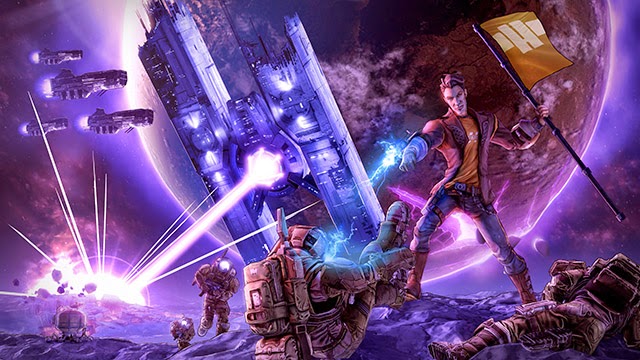
Moonshot: Borderlands Adds a Dark Middle Chapter with 'The Pre-Sequel'


Jack's back! And he's still a tool. In fact, according to the new Borderlands he was always a tool – no personal tragedies or cruel twists of unbiased fate needed here, as jerks are born - not made - in whatever galaxy Pandora is located (actually, that's pretty universal, isn't it?). Gearbox's latest trip to the trippiest planetary system in known space isn't exactly Shakespearean tragedy – Jack's hubris serves him unbelievably well and there's no downfall to be found here – but at least we get to see the bad guy's journey from wisecracking A-with-a-capital-Hole to the mass-murdering malfeasant we've come to love. And hey, it's a trilogy now!

I asked a friend not long ago if he was excited for the 'new Borderlands' and he scoffed, saying “It's not really a new Borderlands”. In a way he was right, though I think perhaps he meant it in a manner less cordial than this game deserves. Borderlands: The Pre-Sequel certainly does not reinvent the wheel, but it does thicken the series' already lively mythology and offer up a generous new helping of all the things that makes Borderlands so damned good – guns, explosions, jokes, and fun. Perhaps inevitably, it also strong-arms the audience into a darker, more deranged place thanks to the downward trajectory of the characters, not to mention a handful of disquieting scenes that sent me to bed early with a glass of warm milk. Alas, TPS tends toward gimmickry and falls a bit shy of it's predecessor's highest of high water marks quality-wise, but the quibbles are largely forgivable when weighed against the sheer volume of shoot-'n-loot that is Borderlands' beloved hallmark.

Honestly, we should be happy Borderlands even made it this far. When Gearbox Software released the original in 2009 it was largely an experiment – a hybrid shooter/role-player that mixed non-stop gunning with level grinding, skill trees and meticulous item management. It might have crashed and burned, or bulwarked the $5 bins in your local game store for years to come. But Borderlands found an audience in people who enjoyed the irreverent tone of the game, the glitzy action, and the ability to tailor chosen characters to their own play style. Add to that the thrill of the LOOT: thousands of weapon combos and the tantalizing carrot that every item recovered was potentially rare, potentially kick-ass and potentially never to be seen again and you had an addictive brew for sure.

Borderlands 2 was a master class in doing a sequel right: Gearbox did everything bigger and better, tweaking the controls, exponentially expanding loot potential, incorporating an actual story and sending us into Pandora's more diverse and colorful environs (a welcome change from the first game's monochromatic trash fields and wastelands). It also introduced one of the most memorable villains in gaming history: motormouthed psychopath Handsome Jack, a genius with a grudge against the entire planet and an unhealthy obsession with Pandora's mysterious energy-spewing Vault. Though he is physically on-screen for less than five minutes, Jack's God-like omnipresence (and ceaseless goading) drove you to the final showdown and the jerkbag's deliciously satisfying defeat.


 The Pre-Sequel takes us back a few years to when Handsome Jack was simply Jack (or 'John' to his hated superiors) and had not yet donned his facsimile face mask or displayed a proclivity for pure evil. Little breadcrumbs from the last game – mostly in the form of audio recordings and the dialogue of supporting characters – had maybe suggested Jack's past was muddled and his descent into villainy not the result of mere megalomania. Eh, not quite. But TPS treats players to a backstory that shows Jack in a (kinda) sympathetic light and makes his hateful mein in the last game (almost) understandable. It also fills in the gaps of what is probably the most interesting time in the series' mythology, the period shortly after the Vault is opened but before Jack uses it's vast Eridium reserves to become the mad tyrant of Pandora. If there's a tragedy here it is the infection on prequel-itis and the sense that we missed out on a more interesting Pandora-based chapter in favor of an entirely new setting; the developers debuted some new toys but told a more cookie-cutter tale in the process.


The action shifts to Pandora's volcanic moon of Elpis, loaded – nay, brimming – with Aussies, as well as the Hyperion Corporation's Helios space station, the H-shaped monstrosity ever-looming in the skies no matter which direction you turn. Jack, a lowly and unappreciated Hyperion engineer, has summoned Vault Hunters to him in secret to exploit what only he knows to be the vast potential of the Vault's contents. The Dahl Corporation has other plans, however, and invades Helios with an armada of ships and an army of space-suited commandos. As Jack's new hire it falls to you to help liberate the space station and strike back against Dahl before proceeding toward the riches of the Vault.

What follows is standard Borderlands fare: blasting from one waypoint to the next with Schwarzeneggerian zeal while ticking off a list of little chores in service to the larger story. Do not EVER expect a switch or lever to work correctly the first time, and if you think you're going to cross any stretch of land or – God help you – a bridge uncontested then you don't know Borderlands and you might, truthfully, be happier playing Mario Kart. It's cool, though, because you're going to need all those kills to level up one of four new classes of playable characters, each for the first time an actual participant in the story with a history – or future role to play – in the series. Veterans of the DLC The Secret Armory of General Knoxx will remember Athena, the assassin from the defunct Atlas Corporation, while Borderlands 2 devotees will recognize both Nisha, the foul-tempered pistolero, and perhaps most famously Wilhelm, the cyborg enforcer who earlier appeared as an evil boss. Rounding it out is Claptrap, the beloved, bumbling trashcan-on-a-unicycle robot that is the unmistakable mascot of the series. How did it take this long to make that dude a playable character?

Something else fans will remember from prior games and DLCs: pacing, which continues to be a problem despite the more focused story and the best efforts of developer 2K Australia. The character's elaborate skill trees demand prodigious leveling – more than can ever be achieved in one playthrough – which most of the time is achieved with long, sloggy slow parts during or between missions where respawning minions are mowed down like wheatgrass and seemingly mundane tasks are arbitrarily stretched to absurd time-chewers. Side missions help push the XP up considerably, but in the case of TPS they seem truly extraneous and forced in what is otherwise supposed to a be beat-the-clock
kind of story. But padding your level becomes indispensable since the story quests surge up in difficulty and you find yourself more overwhelmed and outgunned than usual if you try bulling through the main campaign in one shot. The effect is that so much time elapses between the milestones of the narrative you often forget what it was you were supposed to be doing and – more importantly – why you were doing it. By the end of the second act it is apparent the game is suffering from Phantom Menace-like symptoms as it
burns hours telling a story that doesn't need to be a told, a systemic problem of ALL prequels despite the industry's love of them. The requisite 'big villain' is of little consequence ultimately and her evil scheme never comes to pass anyway. Yet Pandora hangs like an overripe grapefruit in the background, the split in her southern continent visible from space as it spews magenta energy from the newly breached Vault. It's mocking us, reminding us of just how much story there is just over there...if only you can make it past still another jammed door or blown bridge.

There's a steeper learning curve on this title courtesy of Elpis's low gravity, one of the 'gimmicks' to which I referred. Players can bound high into the air, soar across otherwise impassable gaps with ease, and incorporate some offense with the 'gravity slam' – basically smashing your ass down on the ground – for an area-of-effect attack that can be souped up with status mods and bonus damage. The downside of this is that it is a bitch to master – if mastering is indeed possible – and all the while you're struggling to control
your wild flight you're being judiciously peppered with enemy ordinance and schooled mid-air by foes who can outmaneuver you as an F-22 might a balsa plane. It gets easier with practice and any Vault Hunter worth his salt will soon learn to incorporate the new attack into every fight (it's practically a necessity), but while it amps up the challenge it also adds a strange chore-like aspect to every battle, as seeking and winning the highest ground often takes priority over using your guns and skills to maximum effect. Much of the play environment, and indeed many of the mission requirements, utilizes the reformed mobility as a prerequisite to achieving your goals, something casual shooters may find maddening early on. I myself died more in the first 5-7 hours of gameplay than I ever did my entire first playthrough of
Borderlands 2. Your first go at the story is always bound to get you turned around looking for a mission-sensitive item or out-of-the-way door, but with the addition of truly 3D combat Borderlands unrefined 2D maps are more of a hindrance than ever. Expect some gettin' lost time, and don't count on any of the locals giving you helpful directions.

The visuals are eye-popping and often bombastic – the last-gen platforms are definitely getting a workout – but with the caveat that we're in a more truly 'alien' environment than we're used to seeing in this series. Gone are the scintillating glaciers and windswept highlands of Pandora, the rocky coasts and sun-baked mesas. Elpis is a dark-skied place veined with garish stratum, snowy fissures and bizarre colors; only the bright yellow Helios station an exception. It can be bleak and decidedly 'foreign' at the same time and it made me yearn for the more naturalistic environments of past games. Fortunately the gameplay is smattered with familiar faces and references enough to stave off the worst homesickness – ex-Vault Hunters Lillith and Roland are here again as Jack's allies, an ironic turn that Borderlands players know won't last long. Noticeably absent is the most familiar face – a real face – in the Borderlands series, that of actress/model Britanni Johnson as Angel, the Artificial Intelligence guide whose ethereal live-action close-ups keep you company throughout the first two games. A puzzling omission, as this story takes place after Angel's first stint (and a tantalizing hint that she isn't really a computer) but before the stunning revelation in Borderlands 2 that she is, in fact, Jack's super-powered daughter, brutalized and enslaved by him for his evil purposes. Where on Earth (or Pandora) is that story???

In the end I still had a lot of fun despite my quibbles (and really, that's what games are about and Gearbox understands that). Kudos to voice actor Daemen Clark (sp) for once again playing Jack with such cocky abandon, and to the developers for probably the coolest and most inventive skill trees to date – Claptrap's VaultHunter.exe action skill alone is worth a second playthrough. But I couldn't stave off my long-standing animosity toward pre-anything to enjoy TPS perhaps as much as it deserved. Jack was the most interesting character of Borderlands 2 precisely because he was mysterious, his crazed take on the universe and his utter amorality a slap in the face of simple decency and a challenge to one's natural sense of order. But really, folks, when you ask 'Where did that loony come from??', you're speaking rhetorically. Having the question actually answered, especially in a plodding, piecemeal fashion, detracts from the character just as all excess of backstory detracts from any hero – or villain – worth your time.  

Wednesday, September 24, 2014

Bright Lights, Dark City - 'Gotham' (A Polite 'N Prefatory Review)

Riddlers, Penguins and maybe-Jokers (oh my!), but not a Two-Face to been seen. Odd, really, considering the schizophrenic nature of Gotham's premiere episode; ex-D.A. Harvey Dent would definitely be of two minds on the subject. On the one hand there's a passable cop story of corruption and betrayal (soft-boiled but pushing the 8 p.m. envelope for sure), focusing on young Jim Gordon, a newbie do-gooder, and his partner Harvey Bullock, a nihilist drunk, chasing the man who killed the Waynes. On the other you've got a Batman story that does not actually feature Batman, nor will it even should the show run many seasons. On the surface Gotham is a transparent try by DC Comics to milk more cash from their one sure-fire property and to win a timeslot with a wider draw than Arrow can offer. Underneath, however, I detect a genuinely good-hearted attempt to put old wine in new bottles by repackaging the Dark Knight's sacred canon, melding comic mythos and serial sensibilities into a show that wasn't awful and may very well get better.

So, back to the past we go. Just like Smallville, just like Star Trek, just like Terminator, just like the hated Prequels, to scratch the surface. Comedian Patton Oswalt lambasted Hollywood's baffling obsession with backstories with a theory called Jon Voight's Ballsack, i.e. if you like looking at something (Angelina Jolie), it follows that you will equally love the forbearer of that thing (the pink, glistening ball sack of actor Jon Voight from which Ms. Jolie emerged). Ergo, seeing where the things you love came from is just as good as seeing the things you love. Obviously Mr. Oswalt is a detractor, as am I, though I am willing to acknowledge those few exceptions that have proven the rule such as Metal Gear Solid 3: Snake Eater and, yes, Batman Begins. But if Begins was a retelling of Batman's origins, what is Gotham?

In as much as it can be judged from a single episode, it is less of a strict retelling of a pre-Bats Gotham and more of a selective re-imagining of the events and people that birthed him, a sort of 'what if...?' scenario fueled by the grimmest kind of whimsy. If you're a member of the Orthodox Church of the Batman and pillory any departures from immutable Dark Knight lore, this series may be more trouble for you than it's worth. I admit over 48 minutes to eliciting many a harumph myself and rolling my eyes more than a little. There are too many liberties both big and small for this to be considered an adaptation of existing work and the show rips it's britches more than once reconciling the ages, roles, backgrounds and personalities of the characters. Neophytes won't complain, but traditionalists will likely balk at the fuzzy math and blunt characterizations. 

Rather than expound for paragraphs on each detail I thought I'd share a sampling of my notepad from the debut episode - truly, first impressions are the most telling:
  • “Rich city detail, furbelows and visual flare of Gotham – grit, lights, color, sound, steam, skyways(!)...how many composites, how much CG?”
  • “Interesting: Wayne murder off-canon - deliberate handing of pearl necklace, shooting is COLD, INTENTIONAL, not panicked but calm and calculated...”
  • “Gordon's cocky, has a backstory (ugh!), shouldn't have made him a soldier – PTSD bordering on trite...tells B. Wayne 'I know how you feel right now'...NO! NO, HE DOESN'T – HE NEVER HAS – THAT'S WHY JIM GORDON NEVER BECAME BATMAN HIMSELF.” [original caps and underlines from notes]
  • “B. Wayne child actor seems very good.”
  • “Alfred as a Guy Ritchie caricature-slash-soccer hooligan ('Mate' and 'oy!' with a RAISED VOICE!?!?) Not the lessons B-Man needs to learn from him..."
  • “Dire need to hook audience ASAP...abandons subtlety, straight for the carrot – Riddler especially...slow down boy, we've got more episodes...
  • “Jada P. Smith terrible as usual, chewing – gnashing – every goddamn scene...overdone...overdone...3 accents in 3 lines, or just awful at her job?"
  • "Fish Mooney: understand need for non-white faces but Falcone employing non-family turf bosses is way outta character...”
  • “Why is Cobblepot tall? Funny nose/milky complexion not half as important as small stature, dammit!!!”
  • “Good job putting various cops at loggerheads...this is the most believable part...not overbearing, smart...”
  • “They use old cellphones...BECAUSE IT'S THE PAST, GET IT???”
  • “Supermodel wife, free r&b in a high-rise apartment w/a Hell of a view...how much of a sympathetic everyman is JG really??”
  • “End: Don't think Gordon would've played Bullock's 'game', but can see the need to stretch conflict, tension, shows, and was that shot of TOXIC WASTE barrels at the docks supposed to be a hint???"

There's little I despise more than armchair quarterbacking – except maybe premature armchair quarterbacking – so I'll leave it at that. One episode is hardly enough to render a final judgment much less come down on the series for anything worse than quibbles. I will say I am a huge fan of showrunner Bruno Heller's series Rome, and it shouldn't be lost on anyone who followed that series how Heller vaulted the narrative ahead ten years from one episode to another almost without a wrinkle. I wouldn't be surprised if we saw something similar with Gotham should the show survive the ratings crucible; audiences will want to see the seeds sown in these early episodes bear fruit in less time than it will actually take for Wayne to don the cape and cowl. How long do you let a super-villain simmer before he's ready to pop?  We'll see.

And I'll be watching.